| GEOGRAPHY |
| Country name: |
conventional long form: Republic of Belarus
conventional short form: Belarus
local long form: Respublika Byelarus'
local short form: none
former: Belorussian (Byelorussian) Soviet Socialist Republic |
| Capital: |
Minsk |
| Location: |
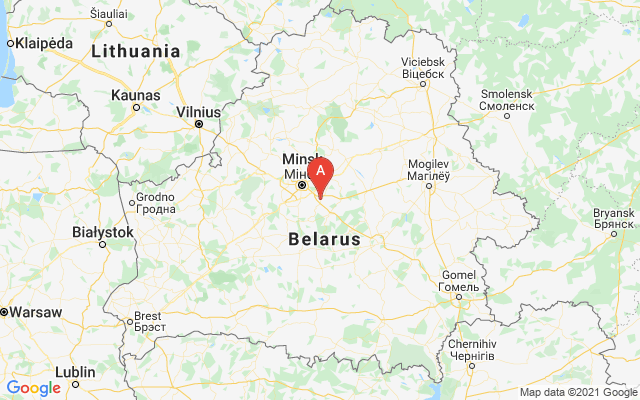
Eastern Europe, east of Poland |
| Geographic
Coordinates: |
53 00 N, 28 00 E |
| Area: |
total: 207,600 sq km
land: 207,600 sq km
water: 0 sq km |
| Area
Comparative: |
slightly smaller than Kansas |
| Land
Boundaries: |
total: 2,900 km
border countries: Latvia 141 km, Lithuania 502 km, Poland 407 km, Russia 959 km, Ukraine 891 km |
| Coastline: |
0 km (landlocked) |
| Maritime
Claims: |
none (landlocked) |
| Climate: |
cold winters, cool and moist summers; transitional between continental and maritime |
| Terrain: |
generally flat and contains much marshland |
| Elavation
Extremes: |
lowest point: Nyoman River 90 m
highest point: Dzyarzhynskaya Hara 346 m |
| Natural
Resources: |
forests, peat deposits, small quantities of oil and natural gas, granite, dolomitic limestone, marl, chalk, sand, gravel, clay |
| GOVERNEMENT |
| Governement
Type: |
republic in name, although in fact a dictatorship |
| Administratives
Divisions: |
6 provinces (voblastsi, singular - voblasts') and 1 municipality* (horad); Brest, Homyel', Horad Minsk*, Hrodna, Mahilyow, Minsk, Vitsyebsk
note: administrative divisions have the same names as their administrative centers |
| Independence |
25 August 1991 (from Soviet Union) |
| National
Holiday: |
Independence Day, 3 July (1944); note - 3 July 1944 was the date Minsk was liberated from German troops, 25 August 1991 was the date of independence from the Soviet Union |
| Constitution: |
30 March 1994; revised by national referendum of 24 November 1996 giving the presidency greatly expanded powers and became effective 27 November 1996; revised again 17 October 2004 removing presidential term limits |
| Legal
System; |
based on civil law system |
| Suffrage |
18 years of age; universal |
| Executive
Branch: |
chief of state: President Aleksandr LUKASHENKO (since 20 July 1994)
head of government: Prime Minister Sergei SIDORSKY (since 19 December 2003); First Deputy Prime Minister Vladimir SEMASHKO (since December 2003); Deputy Prime Ministers Andrei KOBYAKOV (since December 2003), Vladimir DRAZHIN (since 24 September 2001), Ivan BAMBIZA (since 25 May 2004), Anatoly TYUTYUNOV (since July 2002)
cabinet: Council of Ministers
elections: president elected by popular vote for a five-year term; first election took place 23 June and 10 July 1994; according to the 1994 constitution, the next election should have been held in 1999, however LUKASHENKO extended his term to 2001 via a November 1996 referendum; new election held 9 September 2001; October 2004 referendum ended presidential term limits allowing president to run for a third term in September 2006; prime minister and deputy prime ministers appointed by the president
election results: Aleksandr LUKASHENKO reelected president; percent of vote - Aleksandr LUKASHENKO 75.6%, Vladimir GONCHARIK 15.4% |
| Legislative
Branch: |
bicameral Parliament or Natsionalnoye Sobranie consists of the Council of the Republic or Soviet Respubliki (64 seats; 56 members elected by regional councils and 8 members appointed by the president, all for 4-year terms) and the Chamber of Representatives or Palata Predstaviteliy (110 seats; members elected by universal adult suffrage to serve 4-year terms)
elections: last held 18 March and 1 April 2001 and 17 and 31 October 2004 (bi-election will be held March 2005 to fill one unfilled seat in the Palata Predstaviteliy); international observers widely denounced the October 2004 elections as flawed and undemocratic, based on massive government falsification; pro-Lukashenko candidates won every seat, after many opposition candidates were disqualified for technical reasons
election results: Soviet Respubliki - percent of vote by party - NA%; seats by party - NA; Palata Pretsaviteley - percent of vote by party - NA%; seats by party - NA |
| Judicial
Branch: |
Supreme Court (judges are appointed by the president); Constitutional Court (half of the judges appointed by the president and half appointed by the Chamber of Representatives) |
| Political
parties and Leaders: |
Pro-government parties: Agrarian Party or AP; Belarusian Communist Party or KPB; Belarusian Patriotic Movement (Belarusian Patriotic Party) or BPR [Anatoliy BARANKEVICH, chairman]; Liberal Democratic Party of Belarus [Sergei GAYDUKEVICH]; Social-Sports Party; Opposition parties: Belarusian Popular Front or BNF [Vintsuk VYACHORKA]; Belarusian Social-Democrat Party Narodnaya Gromada or BSDP NG [Nikolay STATKEVICH, chairman]; Belarusian Social-Democratic Party Hromada [Stanislav SHUSHKEVICH, chairman]; United Civic Party or UCP [Anatol LEBEDKO]; Party of Communists Belarusian or PKB [Sergei KALYAKIN, chairman]; Women's Party "Nadezhda" [Valentina MATUSEVICH, chairperson]
note: the opposition Belarusian Party of Labor [Aleksandr BUKHVOSTOV] was liquidated in August 2004, but remains active |
| PEOPLE |
| Population: |
10,310,520 (July 2004 est.) |
| Age structure: |
0-14 years: 16.3% (male 859,219; female 823,839)
15-64 years: 69.2% (male 3,469,926; female 3,662,203)
65 years and over: 14.5% (male 496,204; female 999,129) (2004 est.) |
| Median age: |
total: 36.9 years
male: 34.2 years
female: 39.5 years (2004 est.) |
| Nationality: |
noun: Belarusian(s)
adjective: Belarusian |
| Ethnic groups: |
Belarusian 81.2%, Russian 11.4%, Polish, Ukrainian, and other 7.4% |
| Religions: |
Eastern Orthodox 80%, other (including Roman Catholic, Protestant, Jewish, and Muslim) 20% (1997 est.) |
| Languages: |
Belarusian, Russian, other |
| COMUNICATIONS |
| Telephones - main
lines in use: |
3,071,300 (2003) |
| Telephones - mobile
cellular: |
1.118 million (2003) |
| Telephone system: |
general assessment: the Ministry of Telecommunications controls all telecommunications through its carrier (a joint stock company) Beltelcom which is a monopoly
domestic: local - Minsk has a digital metropolitan network and a cellular NMT-450 network; waiting lists for telephones are long; local service outside Minsk is neglected and poor; intercity - Belarus has a partly developed fiber-optic backbone system presently serving at least 13 major cities (1998); Belarus' fiber optics form synchronous digital hierarchy rings through other countries' systems; an inadequate analog system remains operational
international: country code - 375; Belarus is a member of the Trans-European Line (TEL), Trans-Asia-Europe (TAE) fiber-optic line, and has access to the Trans-Siberia Line (TSL); three fiber-optic segments provide connectivity to Latvia, Poland, Russia, and Ukraine; worldwide service is available to Belarus through this infrastructure; additional analog lines to Russia; Intelsat, Eutelsat, and Intersputnik earth stations |
| Radio broadcast
stations: |
AM 28, FM 37, shortwave 11 (1998) |
| Television broadcast
stations: |
47 (plus 27 repeaters) (1995) |
| Internet country
code: |
.by |
| Internet hosts: |
5,308 (2004) |
| Internet users: |
1,391,900 (2003) |
| TRANSPORT |
| Railways: |
total: 5,523 km
broad gauge: 5,523 km 1.520-m gauge (875 km electrified) (2003) |
| Highways: |
total: 74,385 km
paved: 66,203 km
unpaved: 8,182 km (2000) |
| Waterways: |
2,500 km (use limited by location on perimeter of country and by shallowness) (2003) |
| Pipelines: |
gas 5,223 km; oil 2,443 km; refined products 1,686 km (2004) |
| Ports and harbors: |
Mazyr |
| Merchant marine: |
|
| Airports: |
135 (2003 est.) |
| Airports - with
paved runways: |
total: 50
over 3,047 m: 2
2,438 to 3,047 m: 21
1,524 to 2,437 m: 6
under 914 m: 21 (2003 est.) |
| Airports - with
unpaved runways: |
total: 85
over 3,047 m: 3
2,438 to 3,047 m: 2
1,524 to 2,437 m: 5
914 to 1,523 m: 11
under 914 m: 64 (2003 est.) |
| Heliports: |
1 (2003 est.) |