Notice: SSI.php was unable to load a session! This may cause problems with logout and other functions - please make sure SSI.php is included before *anything* else in all your scripts! in /home/blurwqr/public_html/community/SSI.php on line 158
1BluePlanet Uganda
uganda flag of Uganda
Print this pages
Email to a friend Add to Favorites
 
 
Welcome, Guest. Please login or register here


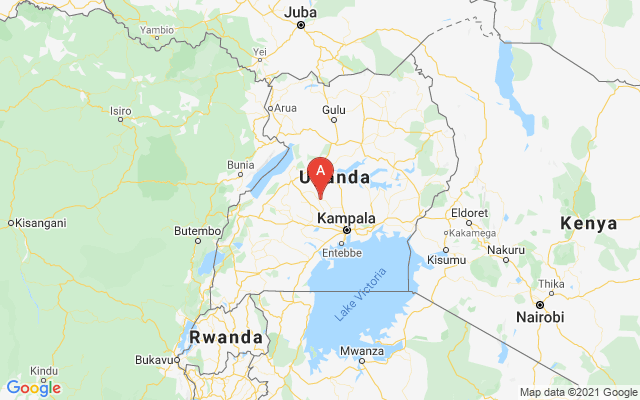
map of Uganda
Introduction: UGANDA
Uganda achieved independence from the UK in 1962. The dictatorial regime of Idi AMIN (1971-79) was responsible for the deaths of some 300,000 opponents; guerrilla war and human rights abuses under Milton OBOTE (1980-85) claimed at least another 100,000 lives. During the 1990s, the government promulgated non-party presidential and legislative elections.
GEOGRAPHY
Country name: conventional long form: Republic of Uganda
conventional short form: Uganda
Capital: Kampala
Location: Eastern Africa, west of Kenya
Geographic Coordinates: 1 00 N, 32 00 E
Area: total: 236,040 sq km
land: 199,710 sq km
water: 36,330 sq km
Area Comparative: slightly smaller than Oregon
Land Boundaries: total: 2,698 km
border countries: Democratic Republic of the Congo 765 km, Kenya 933 km, Rwanda 169 km, Sudan 435 km, Tanzania 396 km
Coastline: 0 km (landlocked)
Maritime Claims: none (landlocked)
Climate: tropical; generally rainy with two dry seasons (December to February, June to August); semiarid in northeast
Terrain: mostly plateau with rim of mountains
Elavation Extremes: lowest point: Lake Albert 621 m
highest point: Margherita Peak on Mount Stanley 5,110 m
Natural Resources: copper, cobalt, hydropower, limestone, salt, arable land
GOVERNEMENT
Governement Type: republic
Administratives Divisions: 56 districts; Adjumani, Apac, Arua, Bugiri, Bundibugyo, Bushenyi, Busia, Gulu, Hoima, Iganga, Jinja, Kabale, Kabarole, Kaberamaido, Kalangala, Kampala, Kamuli, Kamwenge, Kanungu, Kapchorwa, Kasese, Katakwi, Kayunga, Kibale, Kiboga, Kisoro, Kitgum, Kotido, Kumi, Kyenjojo, Lira, Luwero, Masaka, Masindi, Mayuge, Mbale, Mbarara, Moroto, Moyo, Mpigi, Mubende, Mukono, Nakapiripirit, Nakasongola, Nebbi, Ntungamo, Pader, Pallisa, Rakai, Rukungiri, Sembabule, Sironko, Soroti, Tororo, Wakiso, Yumbe
Independence 9 October 1962 (from UK)
National Holiday: Independence Day, 9 October (1962)
Constitution: 8 October 1995; adopted by the interim, 284-member Constituent Assembly, charged with debating the draft constitution that had been proposed in May 1993; the Constituent Assembly was dissolved upon the promulgation of the constitution in October 1995
Legal System; in 1995, the government restored the legal system to one based on English common law and customary law; accepts compulsory ICJ jurisdiction, with reservations
Suffrage 18 years of age; universal
Executive Branch: chief of state: President Lt. Gen. Yoweri Kaguta MUSEVENI (since seizing power 26 January 1986); note - the president is both chief of state and head of government
head of government: President Lt. Gen. Yoweri Kaguta MUSEVENI (since seizing power 29 January 1986); Prime Minister Apollo NSIBAMBI (since 5 April 1999); note - the president is both chief of state and head of government; the prime minister assists the president in the supervision of the cabinet
cabinet: Cabinet appointed by the president from among elected legislators
elections: president reelected by popular vote for a five-year term; election last held 12 March 2001 (next to be held NA 2006); note - first popular election for president since independence in 1962 was held in 1996; prime minister appointed by the president
election results: Lt. Gen. Yoweri Kaguta MUSEVENI elected president; percent of vote - Lt. Gen. Yoweri Kaguta MUSEVENI 69.3%, Kizza BESIGYE 27.8%
Legislative Branch: unicameral National Assembly (303 members - 214 directly elected by popular vote, 81 nominated by legally established special interest groups [women 56, army 10, disabled 5, youth 5, labor 5], 8 ex officio members; members serve five-year terms)
elections: last held 26 June 2001 (next to be held by June 2006);
election results: percent of vote by party - NA%; seats by party - NA; note - election campaigning by party was not permitted
Judicial Branch: Court of Appeal (judges are appointed by the president and approved by the legislature); High Court (judges are appointed by the president)
Political parties and Leaders: only one political organization, the Movement (formerly the NRM)[President MUSEVENI, chairman] is allowed to operate unfettered; note - the president maintains that the Movement is not a political party, but a mass organization, which claims the loyalty of all Ugandans
note: the constitution requires the suspension of political parties while the Movement organization is in governance; of the political parties that exist but are prohibited from sponsoring candidates, the most important are the Ugandan People's Congress or UPC [Milton OBOTE]; Democratic Party or DP [Paul SSEMOGERERE]; Conservative Party or CP [Ken LUKYAMUZI]; Justice Forum [Muhammad Kibirige MAYANJA]; and National Democrats Forum [Chapaa KARUHANGA]
PEOPLE
Population: 27,269,482
note: estimates for this country explicitly take into account the effects of excess mortality due to AIDS; this can result in lower life expectancy, higher infant mortality and death rates, lower population and growth rates, and changes in the distribution of population by age and sex than would otherwise be expected (July 2005 est.)
Age structure: 0-14 years: 50.1% (male 6,875,663/female 6,784,378)
15-64 years: 47.7% (male 6,511,867/female 6,494,859)
65 years and over: 2.2% (male 263,790/female 338,925) (2005 est.)
Median age: total: 14.97 years
male: 14.87 years
female: 15.08 years (2005 est.)
Nationality: noun: Ugandan(s)
adjective: Ugandan
Ethnic groups: Baganda 17%, Ankole 8%, Basoga 8%, Iteso 8%, Bakiga 7%, Langi 6%, Rwanda 6%, Bagisu 5%, Acholi 4%, Lugbara 4%, Batoro 3%, Bunyoro 3%, Alur 2%, Bagwere 2%, Bakonjo 2%, Jopodhola 2%, Karamojong 2%, Rundi 2%, non-African (European, Asian, Arab) 1%, other 8%
Religions: Roman Catholic 33%, Protestant 33%, Muslim 16%, indigenous beliefs 18%
Languages: English (official national language, taught in grade schools, used in courts of law and by most newspapers and some radio broadcasts), Ganda or Luganda (most widely used of the Niger-Congo languages, preferred for native language publications in the capital and may be taught in school), other Niger-Congo languages, Nilo-Saharan languages, Swahili, Arabic
COMUNICATIONS
Telephones - main lines in use: 61,000 (2003)
Telephones - mobile cellular: 776,200 (2003)
Telephone system: general assessment: seriously inadequate; two cellular systems have been introduced, but a sharp increase in the number of main lines is essential; e-mail and Internet services are available
domestic: intercity traffic by wire, microwave radio relay, and radiotelephone communication stations, fixed and mobile cellular systems for short-range traffic
international: country code - 256; satellite earth stations - 1 Intelsat (Atlantic Ocean) and 1 Inmarsat; analog links to Kenya and Tanzania
Radio broadcast stations: AM 7, FM 33, shortwave 2 (2001)
Television broadcast stations: 8 (plus one low-power repeater) (2001)
Internet country code: .ug
Internet hosts: 2,692 (2004)
Internet users: 125,000 (2003)
TRANSPORT
Railways: total: 1,241 km
narrow gauge: 1,241 km 1.000-m gauge (2003)
Highways: total: 27,000 km
paved: 1,809 km
unpaved: 25,191 km (1999 est.)
Waterways: 300 km (on Lake Victoria, 200 km on Lake Albert, Lake Kyoga, and parts of Albert Nile) (2004 est.)
Pipelines:  
Ports and harbors: Entebbe, Jinja, Port Bell
Merchant marine:  
Airports: 29 (2004 est.)
Airports - with paved runways: total: 4
over 3,047 m: 3
1,524 to 2,437 m: 1 (2004 est.)
Airports - with unpaved runways: total: 25
2,438 to 3,047 m: 1
1,524 to 2,437 m: 6
914 to 1,523 m: 11
under 914 m: 7 (2004 est.)
Heliports:  
 
 
Copyright © 1blueplanet.com