| GEOGRAPHY |
| Country name: |
conventional long form: Republic of the Sudan
conventional short form: Sudan
local long form: Jumhuriyat as-Sudan
local short form: As-Sudan
former: Anglo-Egyptian Sudan |
| Capital: |
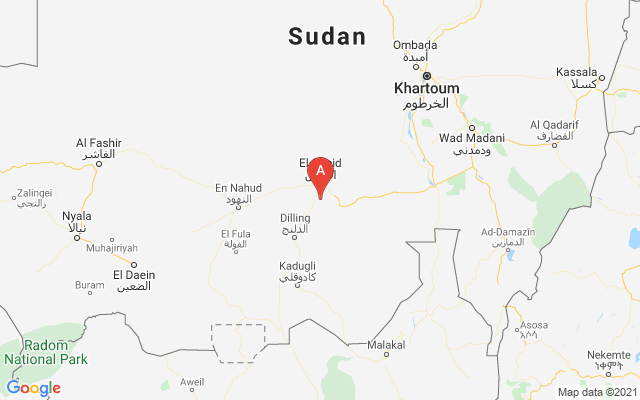
Khartoum |
| Location: |
Northern Africa, bordering the Red Sea, between Egypt and Eritrea |
| Geographic
Coordinates: |
15 00 N, 30 00 E |
| Area: |
total: 2,505,810 sq km
land: 2.376 million sq km
water: 129,810 sq km |
| Area
Comparative: |
slightly more than one-quarter the size of the US |
| Land
Boundaries: |
total: 7,687 km
border countries: Central African Republic 1,165 km, Chad 1,360 km, Democratic Republic of the Congo 628 km, Egypt 1,273 km, Eritrea 605 km, Ethiopia 1,606 km, Kenya 232 km, Libya 383 km, Uganda 435 km |
| Coastline: |
853 km |
| Maritime
Claims: |
territorial sea: 12 nm
contiguous zone: 18 nm
continental shelf: 200-m depth or to the depth of exploitation |
| Climate: |
tropical in south; arid desert in north; rainy season varies by region (April to November) |
| Terrain: |
generally flat, featureless plain; mountains in far south, northeast and west; desert dominates the north |
| Elavation
Extremes: |
lowest point: Red Sea 0 m
highest point: Kinyeti 3,187 m |
| Natural
Resources: |
petroleum; small reserves of iron ore, copper, chromium ore, zinc, tungsten, mica, silver, gold, hydropower |
| GOVERNEMENT |
| Governement
Type: |
authoritarian regime - ruling military junta took power in 1989; government is run by an alliance of the military and the National Congress Party (NCP), formerly the National Islamic Front (NIF), which espouses an Islamist platform |
| Administratives
Divisions: |
26 states (wilayat, singular - wilayah); A'ali an Nil, Al Bahr al Ahmar, Al Buhayrat, Al Jazirah, Al Khartum, Al Qadarif, Al Wahdah, An Nil al Abyad, An Nil al Azraq, Ash Shamaliyah, Bahr al Jabal, Gharb al Istiwa'iyah, Gharb Bahr al Ghazal, Gharb Darfur, Gharb Kurdufan, Janub Darfur, Janub Kurdufan, Junqali, Kassala, Nahr an Nil, Shamal Bahr al Ghazal, Shamal Darfur, Shamal Kurdufan, Sharq al Istiwa'iyah, Sinnar, Warab |
| Independence |
1 January 1956 (from Egypt and UK) |
| National
Holiday: |
Independence Day, 1 January (1956) |
| Constitution: |
12 April 1973, suspended following coup of 6 April 1985; interim constitution of 10 October 1985 suspended following coup of 30 June 1989; new constitution implemented on 30 June 1998 partially suspended 12 December 1999 by President BASHIR |
| Legal
System; |
based on English common law and Islamic law; as of 20 January 1991, the now defunct Revolutionary Command Council imposed Islamic law in the northern states; Islamic law applies to all residents of the northern states regardless of their religion; some separate religious courts; accepts compulsory ICJ jurisdiction, with reservations |
| Suffrage |
17 years of age; universal, but noncompulsory |
| Executive
Branch: |
chief of state: President Field Marshall Umar Hassan Ahmad al-BASHIR (since 16 October 1993); First Vice President Ali Uthman Muhammad TAHA (since 17 February 1998), Second Vice President Moses MACHAR (since 12 February 2001); note - the president is both the chief of state and head of government
head of government: President Field Marshall Umar Hassan Ahmad al-BASHIR (since 16 October 1993); First Vice President Ali Uthman Muhammad TAHA (since 17 February 1998), Second Vice President Moses MACHAR (since 12 February 2001); note - the president is both the chief of state and head of government
cabinet: Council of Ministers appointed by the president; note - the National Congress Party or NCP (formerly the National Islamic Front or NIF) dominates al-BASHIR's cabinet
elections: president elected by popular vote for a five-year term; election last held 13-23 December 2000 (next to be held NA)
election results: Field Marshall Umar Hassan Ahmad al-BASHIR reelected president; percent of vote - Umar Hassan Ahmad al-BASHIR 86.5%, Ja'afar Muhammed NUMAYRI 9.6%, three other candidates received a combined vote of 3.9%; election widely viewed as rigged; all popular opposition parties boycotted elections because of a lack of guarantees for a free and fair election
note: al-BASHIR assumed power as chairman of Sudan's Revolutionary Command Council for National Salvation (RCC) in June 1989 and served concurrently as chief of state, chairman of the RCC, prime minister, and minister of defense until mid-October 1993 when he was appointed president by the RCC; he was elected president by popular vote for the first time in March 1996 |
| Legislative
Branch: |
unicameral National Assembly (360 seats; 270 popularly elected, 90 elected by supra assembly of interest groups known as National Congress; members serve four-year terms)
elections: last held 13-22 December 2000 (next to be held NA)
election results: NCP 355, others 5 |
| Judicial
Branch: |
Supreme Court; Special Revolutionary Courts |
| Political
parties and Leaders: |
the government allows political "associations" under a 1998 law revised in 2000; to obtain government approval parties must accept the constitution and refrain from advocating or using violence against the regime; approved parties include the National Congress Party or NCP [Ibrahim Ahmed UMAR], Popular National Congress or PNC [Hassan al-TURABI], and over 20 minor, pro-government parties |
| PEOPLE |
| Population: |
40,187,486 (July 2005 est.) |
| Age structure: |
0-14 years: 43.2% (male 8,865,331/female 8,488,982)
15-64 years: 54.5% (male 10,952,566/female 10,930,218)
65 years and over: 2.4% (male 513,679/female 436,710) (2005 est.) |
| Median age: |
total: 18.07 years
male: 17.86 years
female: 18.29 years (2005 est.) |
| Nationality: |
noun: Sudanese (singular and plural)
adjective: Sudanese |
| Ethnic groups: |
black 52%, Arab 39%, Beja 6%, foreigners 2%, other 1% |
| Religions: |
Sunni Muslim 70% (in north), indigenous beliefs 25%, Christian 5% (mostly in south and Khartoum) |
| Languages: |
Arabic (official), Nubian, Ta Bedawie, diverse dialects of Nilotic, Nilo-Hamitic, Sudanic languages, English
note: program of "Arabization" in process |
| COMUNICATIONS |
| Telephones - main
lines in use: |
900,000 (2003) |
| Telephones - mobile
cellular: |
650,000 (2003) |
| Telephone system: |
general assessment: large, well-equipped system by regional standards and being upgraded; cellular communications started in 1996 and have expanded substantially
domestic: consists of microwave radio relay, cable, radiotelephone communications, tropospheric scatter, and a domestic satellite system with 14 earth stations
international: country code - 249; satellite earth stations - 1 Intelsat (Atlantic Ocean) and 1 Arabsat (2000) |
| Radio broadcast
stations: |
AM 12, FM 1, shortwave 1 (1998) |
| Television broadcast
stations: |
3 (1997) |
| Internet country
code: |
.sd |
| Internet hosts: |
NA |
| Internet users: |
300,000 (2003) |
| TRANSPORT |
| Railways: |
total: 5,995 km
narrow gauge: 4,595 km 1.067-m gauge; 1,400 km .600-m gauge for cotton plantations (2003) |
| Highways: |
total: 11,900 km
paved: 4,320 km
unpaved: 7,580 km (1999 est.) |
| Waterways: |
4,068 km (1,723 km open year round on White and Blue Nile rivers) (2004) |
| Pipelines: |
gas 156 km; oil 2,365 km; refined products 810 km (2004) |
| Ports and harbors: |
Juba, Khartoum, Kusti, Malakal, Nimule, Port Sudan, Sawakin |
| Merchant marine: |
total: 2 ships (1,000 GRT or over) 20,466 GRT/26,973 DWT
by type: cargo 1, livestock carrier 1
registered in other countries: 2 (2005) |
| Airports: |
75 (2004 est.) |
| Airports - with
paved runways: |
total: 12
over 3,047 m: 1
2,438 to 3,047 m: 8
1,524 to 2,437 m: 3 (2004 est.) |
| Airports - with
unpaved runways: |
total: 63
over 3,047 m: 1
2,438 to 3,047 m: 1
1,524 to 2,437 m: 17
914 to 1,523 m: 33
under 914 m: 11 (2004 est.) |
| Heliports: |
2 (2004 est.) |
|