Notice: SSI.php was unable to load a session! This may cause problems with logout and other functions - please make sure SSI.php is included before *anything* else in all your scripts! in /home/blurwqr/public_html/community/SSI.php on line 158
1BluePlanet Samoa
samoa flag of Samoa
Print this pages
Email to a friend Add to Favorites
 
 
Welcome, Guest. Please login or register here


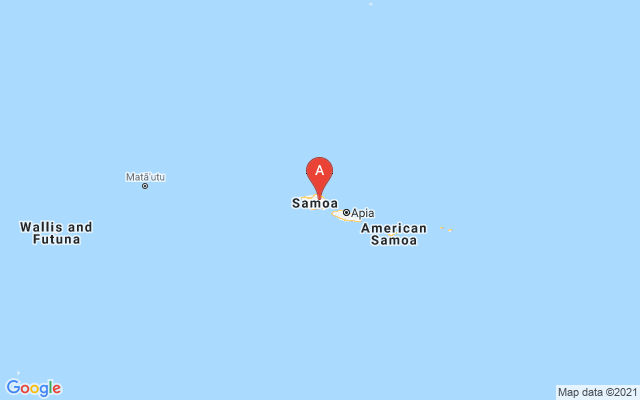
map of Samoa
Introduction: SAMOA
New Zealand occupied the German protectorate of Western Samoa at the outbreak of World War I in 1914. It continued to administer the islands as a mandate and then as a trust territory until 1962, when the islands became the first Polynesian nation to reestablish independence in the 20th century. The country dropped the "Western" from its name in 1997.
GEOGRAPHY
Country name: conventional long form: Independent State of Samoa
conventional short form: Samoa
former: Western Samoa
Capital: Apia
Location: Oceania, group of islands in the South Pacific Ocean, about one-half of the way from Hawaii to New Zealand
Geographic Coordinates: 13 35 S, 172 20 W
Area: total: 2,944 sq km
land: 2,934 sq km
water: 10 sq km
Area Comparative: slightly smaller than Rhode Island
Land Boundaries: 0 km
Coastline: 403 km
Maritime Claims: territorial sea: 12 nm
exclusive economic zone: 200 nm
Climate: tropical; rainy season (November to April), dry season (May to October)
Terrain: two main islands (Savaii, Upolu) and several smaller islands and uninhabited islets; narrow coastal plain with volcanic, rocky, rugged mountains in interior
Elavation Extremes: lowest point: Pacific Ocean 0 m
highest point: Mauga Silisili (Savaii) 1,857 m
Natural Resources: hardwood forests, fish, hydropower
GOVERNEMENT
Governement Type: mix of parliamentary democracy and constitutional monarchy
Administratives Divisions: 11 districts; A'ana, Aiga-i-le-Tai, Atua, Fa'asaleleaga, Gaga'emauga, Gagaifomauga, Palauli, Satupa'itea, Tuamasaga, Va'a-o-Fonoti, Vaisigano
Independence 1 January 1962 (from New Zealand-administered UN trusteeship)
National Holiday: Independence Day Celebration, 1 June (1962); note - 1 January 1962 is the date of independence from the New Zealand-administered UN trusteeship, 1 June 1962 is the date that independence is celebrated
Constitution: 1 January 1962
Legal System; based on English common law and local customs; judicial review of legislative acts with respect to fundamental rights of the citizen; has not accepted compulsory ICJ jurisdiction
Suffrage 21 years of age; universal
Executive Branch: chief of state: Chief Tanumafili II MALIETOA (cochief of state from 1 January 1962 until becoming sole chief of state 5 April 1963)
head of government: Prime Minister Sailele Malielegaoi TUILA'EPA (since 1996); note - TUILA'EPA served as deputy prime minister from 1992 and assumed the duties of acting prime minister in 1996, when former Prime Minister TOFILAU Eti Alesana resigned in poor health; TUILA'EPA was confirmed as prime minister (November 1998) after TOFILAU died; Deputy Prime Minister MISA Telefoni (since 2001)
cabinet: Cabinet consists of 12 members, appointed by the chief of state on the prime minister's advice
elections: upon the death of Chief Tanumafili II MALIETOA, a new chief of state will be elected by the Legislative Assembly to serve a five-year term; following legislative elections, the leader of the majority party is usually appointed prime minister by the chief of state with the approval of the Legislative Assembly
Legislative Branch: unicameral Legislative Assembly or Fono (49 seats - 47 elected by voters affiliated with traditional village-based electoral districts, 2 elected by independent, mostly non-Samoan or part-Samoan, voters who cannot, (or choose not to) establish a village affiliation; only chiefs (matai) may stand for election to the Fono from the 47 village-based electorates; members serve five-year terms)
elections: election last held 3 March 2001 (next election to be held not later than March 2006)
election results: percent of vote by party - NA%; seats by party - HRPP 30, SNDP 13, independents 6
Judicial Branch: Court of Appeal; Supreme Court; District Court; Land and Titles Court
Political parties and Leaders: Christian Democratic Party [leader NA]; Human Rights Protection Party or HRPP [Sailele Malielegaoi TUILA'EPA, chairman]; Samoan Democratic United Party or SDUP[LE MAMEA Ropati, chairman] (opposition); Samoa National Development Party or SNDP [leader, NA]
PEOPLE
Population: 177,287 (July 2005 est.)
Age structure: 0-14 years: 27.2% (male 24,517/female 23,660)
15-64 years: 66.4% (male 73,495/female 44,208)
65 years and over: 6.4% (male 5,204/female 6,203) (2005 est.)
Median age: total: 24.59 years
male: 27.42 years
female: 21.42 years (2005 est.)
Nationality: noun: Samoan(s)
adjective: Samoan
Ethnic groups: Samoan 92.6%, Euronesians 7% (persons of European and Polynesian blood), Europeans 0.4%
Religions: Christian 99.7% (about one-half of population associated with the London Missionary Society; includes Congregational, Roman Catholic, Methodist, Latter-Day Saints, Seventh-Day Adventist)
Languages: Samoan (Polynesian), English
COMUNICATIONS
Telephones - main lines in use: 11,800 (2002)
Telephones - mobile cellular: 2,700 (2002)
Telephone system: general assessment: adequate
domestic: NA
international: country code - 685; satellite earth station - 1 Intelsat (Pacific Ocean)
Radio broadcast stations: AM 2, FM 5, shortwave 0 (2004)
Television broadcast stations: 2 (2002)
Internet country code: .ws
Internet hosts: 8,225 (2003)
Internet users: 4,000 (2002)
TRANSPORT
Railways:  
Highways: total: 790 km
paved: 332 km
unpaved: 458 km (1999 est.)
Waterways:  
Pipelines:  
Ports and harbors: Apia, Asau, Mulifanua, Salelologa
Merchant marine: total: 1 ships (1,000 GRT or over) 7,091 GRT/8,127 DWT
by type: cargo 1
foreign-owned: 1 (Germany 1) (2005)
Airports: 4 (2004 est.)
Airports - with paved runways: total: 3
2,438 to 3,047 m: 1
under 914 m: 2 (2004 est.)
Airports - with unpaved runways: total: 1
under 914 m: 1 (2004 est.)
Heliports:  
 
 
Copyright © 1blueplanet.com