Notice: SSI.php was unable to load a session! This may cause problems with logout and other functions - please make sure SSI.php is included before *anything* else in all your scripts! in /home/blurwqr/public_html/community/SSI.php on line 158
1BluePlanet Rwanda
rwanda flag of Rwanda
Print this pages
Email to a friend Add to Favorites
 
 
Welcome, Guest. Please login or register here


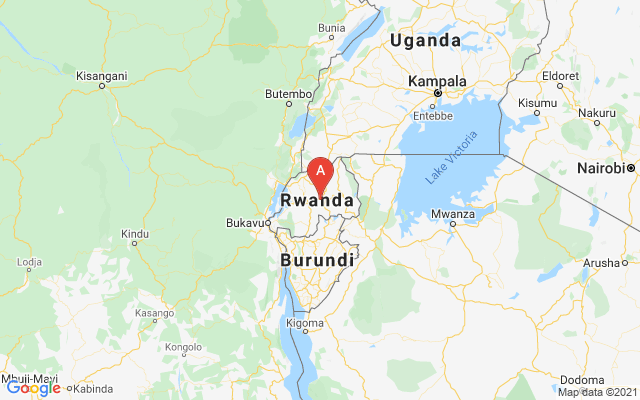
map of Rwanda
Introduction: RWANDA
In 1959, three years before independence from Belgium, the majority ethnic group, the Hutus, overthrew the ruling Tutsi king. Over the next several years, thousands of Tutsis were killed, and some 150,000 driven into exile in neighboring countries. The children of these exiles later formed a rebel group, the Rwandan Patriotic Front (RPF), and began a civil war in 1990. The war, along with several political and economic upheavals, exacerbated ethnic tensions, culminating in April 1994 in the genocide of roughly 800,000 Tutsis and moderate Hutus. The Tutsi rebels defeated the Hutu regime and ended the killing in July 1994, but approximately 2 million Hutu refugees - many fearing Tutsi retribution - fled to neighboring Burundi, Tanzania, Uganda, and the former Zaire. Since then, most of the refugees have returned to Rwanda, but about 10,000 that remain in the neighboring Democratic Republic of the Congo have formed an extremist insurgency bent on retaking Rwanda, much as the RPF tried in 1990. Despite substantial international assistance and political reforms - including Rwanda's first local elections in March 1999 and its first post-genocide presidential and legislative elections in August and September 2003, respectively - the country continues to struggle to boost investment and agricultural output, and ethnic reconciliation is complicated by the real and perceived Tutsi political dominance. Kigali's increasing centralization and intolerance of dissent, the nagging Hutu extremist insurgency across the border, and Rwandan involvement in two wars in recent years in the neighboring Democratic Republic of the Congo continue to hinder Rwanda's efforts to escape its bloody legacy.
GEOGRAPHY
Country name: conventional long form: Republic of Rwanda
conventional short form: Rwanda
local long form: Republika y'u Rwanda
local short form: Rwanda
former: Ruanda
Capital: Kigali
Location: Central Africa, east of Democratic Republic of the Congo
Geographic Coordinates: 2 00 S, 30 00 E
Area: total: 26,338 sq km
land: 24,948 sq km
water: 1,390 sq km
Area Comparative: slightly smaller than Maryland
Land Boundaries: total: 893 km
border countries: Burundi 290 km, Democratic Republic of the Congo 217 km, Tanzania 217 km, Uganda 169 km
Coastline: 0 km (landlocked)
Maritime Claims: none (landlocked)
Climate: temperate; two rainy seasons (February to April, November to January); mild in mountains with frost and snow possible
Terrain: mostly grassy uplands and hills; relief is mountainous with altitude declining from west to east
Elavation Extremes: lowest point: Rusizi River 950 m
highest point: Volcan Karisimbi 4,519 m
Natural Resources: gold, cassiterite (tin ore), wolframite (tungsten ore), methane, hydropower, arable land
GOVERNEMENT
Governement Type: republic; presidential, multiparty system
Administratives Divisions: 12 provinces (in French - provinces, singular - province; in Kinyarwanda - prefigintara for singular and plural); Butare, Byumba, Cyangugu, Gikongoro, Gisenyi, Gitarama, Kibungo, Kibuye, Kigali Rurale, Kigali-ville, Umutara, Ruhengeri
Independence 1 July 1962 (from Belgium-administered UN trusteeship)
National Holiday: Independence Day, 1 July (1962)
Constitution: a new constitution was adopted 4 June 2003
Legal System; based on German and Belgian civil law systems and customary law; judicial review of legislative acts in the Supreme Court; has not accepted compulsory ICJ jurisdiction
Suffrage 18 years of age; universal adult
Executive Branch: chief of state: President Paul KAGAME (since 22 April 2000)
head of government: Prime Minister Bernard MAKUZA (since 8 March 2000)
cabinet: Council of Ministers appointed by the president
elections: last held 25 August 2003 (next to be held NA 2008)
election results: Paul KAGAME elected president in first direct popular vote; Paul KAGAME 95.05%, Faustin TWAGIRAMUNGU 3.62%, Jean-Nepomuscene NAYINZIRA 1.33%
Legislative Branch: unicameral National Assembly or Assemblee Nationale (53 seats; members elected by direct vote)
elections: last held 29 September 2003 (next to be held NA 2008 - Chamber of Deputies; NA 2011 - Senate)
election results: seats by party under the 2003 Constitution - RPF 40, PSD 7, PL 6
Judicial Branch: Supreme Court; High Courts of the Republic; Provincial Courts; District Courts; mediation committees
Political parties and Leaders: Centrist Democratic Party or PDC [Alfred MUKEZAMFURA]; Democratic Popular Union of Rwanda or UDPR [Adrien RANGIRA]; Democratic Republican Movement or MDR (officially banned) [Celestin KABANDA]; Islamic Democratic Party or PDI [Andre BUMAYA]; Liberal Party or PL [Prosper HIGIRO]; Party for Democratic Renewal (officially banned) [Pasteur BIZIMUNGU and Charles NTAKARUTINKA]; Rwandan Patriotic Front or RPF [Paul KAGAME]; Social Democratic Party or PSD [Vincent BIRUTA]
PEOPLE
Population: 8,440,820
note: estimates for this country explicitly take into account the effects of excess mortality due to AIDS; this can result in lower life expectancy, higher infant mortality and death rates, lower population and growth rates, and changes in the distribution of population by age and sex than would otherwise be expected (July 2005 est.)
Age structure: 0-14 years: 41.9% (male 1,777,178/female 1,762,252)
15-64 years: 55.5% (male 2,328,686/female 2,356,572)
65 years and over: 2.6% (male 87,155/female 128,977) (2005 est.)
Median age: total: 18.48 years
male: 18.26 years
female: 18.7 years (2005 est.)
Nationality: noun: Rwandan(s)
adjective: Rwandan
Ethnic groups: Hutu 84%, Tutsi 15%, Twa (Pygmoid) 1%
Religions: Roman Catholic 56.5%, Protestant 26%, Adventist 11.1%, Muslim 4.6%, indigenous beliefs 0.1%, none 1.7% (2001)
Languages: Kinyarwanda (official) universal Bantu vernacular, French (official), English (official), Kiswahili (Swahili) used in commercial centers
COMUNICATIONS
Telephones - main lines in use: 23,200 (2002)
Telephones - mobile cellular: 134,000
note: Rwanda has mobile cellular service between Kigali and several provincial capitals (2003)
Telephone system: general assessment: telephone system primarily serves business and government
domestic: the capital, Kigali, is connected to the centers of the provinces by microwave radio relay and, recently, by cellular telephone service; much of the network depends on wire and HF radiotelephone
international: country code - 250; international connections employ microwave radio relay to neighboring countries and satellite communications to more distant countries; satellite earth stations - 1 Intelsat (Indian Ocean) in Kigali (includes telex and telefax service)
Radio broadcast stations: AM 0, FM 8 (two main FM programs are broadcast through a system of repeaters, three international FM programs include the BBC, VOA, and Deutchewelle), shortwave 1 (2005)
Television broadcast stations: 2 (2004)
Internet country code: .rw
Internet hosts: 1,495 (2003)
Internet users: 25,000 (2002)
TRANSPORT
Railways:  
Highways: total: 12,000 km
paved: 996 km
unpaved: 11,004 km (1999 est.)
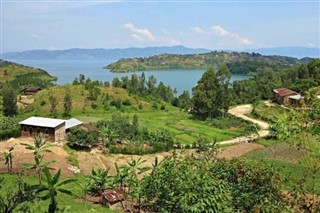
Waterways: Lac Kivu navigable by shallow-draft barges and native craft (2004)
Pipelines:  
Ports and harbors: Cyangugu, Gisenyi, Kibuye
Merchant marine:  
Airports: 9 (2004 est.)
Airports - with paved runways: total: 4
over 3,047 m: 1
914 to 1,523 m: 2
under 914 m: 1 (2004 est.)
Airports - with unpaved runways: total: 5
914 to 1,523 m: 2
under 914 m: 3 (2004 est.)
Heliports:  
 
 
Copyright © 1blueplanet.com