Notice: SSI.php was unable to load a session! This may cause problems with logout and other functions - please make sure SSI.php is included before *anything* else in all your scripts! in /home/blurwqr/public_html/community/SSI.php on line 158
1BluePlanet Papua New Guinea
papua new guinea flag of Papua New Guinea
Print this pages
Email to a friend Add to Favorites
 
 
Welcome, Guest. Please login or register here


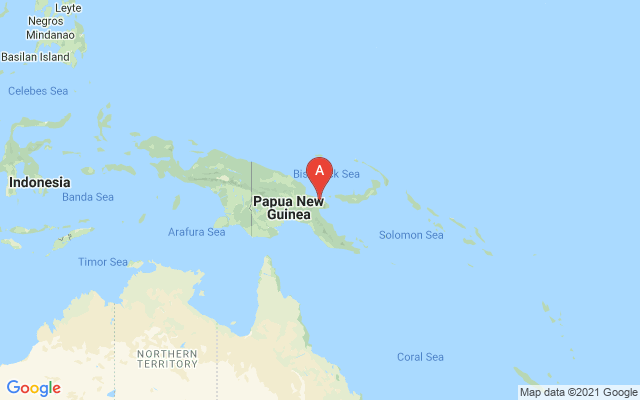
map of Papua New Guinea
Introduction: PAPUA NEW GUINEA
The eastern half of the island of New Guinea - second largest in the world - was divided between Germany (north) and the UK (south) in 1885. The latter area was transferred to Australia in 1902, which occupied the northern portion during World War I and continued to administer the combined areas until independence in 1975. A nine-year secessionist revolt on the island of Bougainville ended in 1997 after claiming some 20,000 lives.
GEOGRAPHY
Country name: conventional long form: Independent State of Papua New Guinea
conventional short form: Papua New Guinea
former: Territory of Papua and New Guinea
abbreviation: PNG
Capital: Port Moresby
Location: Oceania, group of islands including the eastern half of the island of New Guinea between the Coral Sea and the South Pacific Ocean, east of Indonesia
Geographic Coordinates: 6 00 S, 147 00 E
Area: total: 462,840 sq km
land: 452,860 sq km
water: 9,980 sq km
Area Comparative: slightly larger than California
Land Boundaries: total: 820 km
border countries: Indonesia 820 km
Coastline: 5,152 km
Maritime Claims: measured from claimed archipelagic baselines
territorial sea: 12 nm
continental shelf: 200-m depth or to the depth of exploitation
exclusive fishing zone: 200 nm
Climate: tropical; northwest monsoon (December to March), southeast monsoon (May to October); slight seasonal temperature variation
Terrain: mostly mountains with coastal lowlands and rolling foothills
Elavation Extremes: lowest point: Pacific Ocean 0 m
highest point: Mount Wilhelm 4,509 m
Natural Resources: gold, copper, silver, natural gas, timber, oil, fisheries
GOVERNEMENT
Governement Type: constitutional monarchy with parliamentary democracy
Administratives Divisions: 20 provinces; Bougainville, Central, Chimbu, Eastern Highlands, East New Britain, East Sepik, Enga, Gulf, Madang, Manus, Milne Bay, Morobe, National Capital, New Ireland, Northern, Sandaun, Southern Highlands, Western, Western Highlands, West New Britain
Independence 16 September 1975 (from the Australian-administered UN trusteeship)
National Holiday: Independence Day, 16 September (1975)
Constitution: 16 September 1975
Legal System; based on English common law
Suffrage 18 years of age; universal
Executive Branch: chief of state: Queen ELIZABETH II (since 6 February 1952), represented by governor general Sir Paulius MATANE (since 29 June 2004)
head of government: Prime Minister Sir Michael SOMARE (since 2 August 2002); deputy prime minister (vacant)
cabinet: National Executive Council appointed by the governor general on the recommendation of the prime minister
elections: none; the monarch is hereditary; governor general appointed by the National Executive Council; following legislative elections, the leader of the majority party or the leader of the majority coalition usually is appointed prime minister by the governor general
Legislative Branch: unicameral National Parliament - sometimes referred to as the House of Assembly (109 seats, 89 elected from open electorates and 20 from provincial electorates; members elected by popular vote to serve five-year terms)
elections: last held 15-29 June 2002 and April and May 2003; completed in May 2003 (voting in the Southern Highlands was not completed during the June 2002 election period); next to be held not later than June 2007
election results: percent of vote by party - National Alliance 18%, URP 13%, PDM 12%, PPP 8%, Pangu 6%, PAP 5%, PLP 4%, others 34%; seats by party - National Alliance 19, URP 14, PDM 13, PPP 8, PANGU 6, PAP 5, PLP 4, others 40; note - association with political parties is fluid (2003)
Judicial Branch: Supreme Court (the chief justice is appointed by the governor general on the proposal of the National Executive Council after consultation with the minister responsible for justice; other judges are appointed by the Judicial and Legal Services Commission)
Political parties and Leaders: Christian Democratic Party [Dr. Banare BUN, party leader]; Melanesian Alliance Party or MAP [Sir Moi AVEL, party leader]; National Alliance Party or NA [Michael SOMARE, party leader; George MANOA, party president]; National Party [Melchior PEP, party leader]; Papua and Niugini Union Party or PANGU [Chris HAIVETA, party leader]; Papua New Guinea First Party [Cecilking DORUBA, party leader]; Papua New Guinea Labor Party [Bob DANAYA, party leader]; Papua New Guinea Party (was People's Democratic Movement or PDM) [Sir Mekere MORAUTA, party leader]; People's Action Party or PAP [Moses MALADINA, party leader]; People's Labor Party or PLP [Ekis ROPENU, party leader]; People's National Congress or PNC [Peter O'NEILL, party leader]; People's Progressive Party or PPP [Andrew BAING, party leader]; Pipol First Party [Luther WENGE, party leader]; Rural People's Party [Peter NAMUS, party leader]; United Party [Bire KIMASOPA, party leader]; United Resources Party or URP [Tim NEVILLE, party leader] (2004)
PEOPLE
Population: 5,545,268 (July 2005 est.)
Age structure: 0-14 years: 38.1% (male 1,072,910/female 1,037,635)
15-64 years: 58.1% (male 1,662,166/female 1,559,685)
65 years and over: 3.8% (male 99,777/female 113,095) (2005 est.)
Median age: total: 21.09 years
male: 21.25 years
female: 20.93 years (2005 est.)
Nationality: noun: Papua New Guinean(s)
adjective: Papua New Guinean
Ethnic groups: Melanesian, Papuan, Negrito, Micronesian, Polynesian
Religions: Roman Catholic 22%, Lutheran 16%, Presbyterian/Methodist/London Missionary Society 8%, Anglican 5%, Evangelical Alliance 4%, Seventh-Day Adventist 1%, other Protestant 10%, indigenous beliefs 34%
Languages: Melanesian Pidgin serves as the lingua franca, English spoken by 1%-2%, Motu spoken in Papua region
note: 715 indigenous languages - many unrelated
COMUNICATIONS
Telephones - main lines in use: 62,000 (2002)
Telephones - mobile cellular: 15,000 (2002)
Telephone system: general assessment: services are adequate; facilities provide radiotelephone and telegraph, coastal radio, aeronautical radio, and international radio communication services
domestic: mostly radiotelephone
international: country code - 675; submarine cables to Australia and Guam; satellite earth station - 1 Intelsat (Pacific Ocean); international radio communication service
Radio broadcast stations: AM 8, FM 19, shortwave 28 (1998)
Television broadcast stations: 3 (all in the Port Moresby area)
note: additional stations at Mt. Hagen, Goroka, Lae, and Rabaul are planned (2004)
Internet country code: .pg
Internet hosts: 389 (2003)
Internet users: 75,000 (2002)
TRANSPORT
Railways:  
Highways: total: 19,600 km
paved: 686 km
unpaved: 18,914 km (1999 est.)
Waterways: 10,940 km (2003)
Pipelines: oil 264 km (2004)
Ports and harbors: Kieta, Lae, Madang, Port Moresby, Rabaul
Merchant marine: total: 22 ships (1,000 GRT or over) 47,586 GRT/60,934 DWT
by type: bulk carrier 2, cargo 17, chemical tanker 1, petroleum tanker 2
foreign-owned: 8 (Singapore 2, United Kingdom 6) (2005)
Airports: 571 (2004 est.)
Airports - with paved runways:  
Airports - with unpaved runways: total: 550
1,524 to 2,437 m: 10
914 to 1,523 m: 62
under 914 m: 478 (2004 est.)
Heliports: 2 (2004 est.)
 
 
Copyright © 1blueplanet.com