Notice: SSI.php was unable to load a session! This may cause problems with logout and other functions - please make sure SSI.php is included before *anything* else in all your scripts! in /home/blurwqr/public_html/community/SSI.php on line 158
1BluePlanet Nepal
Nepal flag of Nepal
Print this pages
Email to a friend Add to Favorites
 
 
Welcome, Guest. Please login or register here


flag of Nepal
Introduction: NEPAL
In 1951, the Nepalese monarch ended the century-old system of rule by hereditary premiers and instituted a cabinet system of government. Reforms in 1990 established a multiparty democracy within the framework of a constitutional monarchy. A Maoist insurgency, launched in 1996, has gained traction and is threatening to bring down the regime, especially after a negotiated cease-fire between the Maoists and government forces broke down in August 2003. In 2001, the crown prince massacred ten members of the royal family, including the king and queen, and then took his own life. In October 2002, the new king dismissed the prime minister and his cabinet for "incompetence" after they dissolved the parliament and were subsequently unable to hold elections because of the ongoing insurgency. While stopping short of reestablishing parliament, the king in June 2004 reinstated the most recently elected Prime Minister who formed a four-party coalition government, which the king subsequently tasked with paving the way for elections to be held in spring of 2005.
GEOGRAPHY
Country name: conventional long form: Kingdom of Nepal
conventional short form: Nepal
Capital: Kathmandu
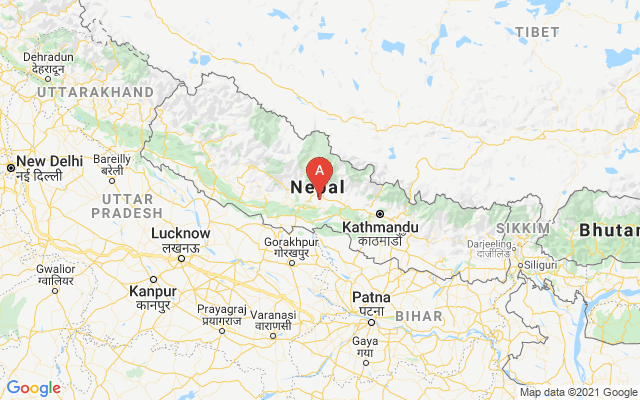
Location: Southern Asia, between China and India
Geographic Coordinates: 28 00 N, 84 00 E
Area: total: 140,800 sq km
land: 136,800 sq km
water: 4,000 sq km
Area Comparative: slightly larger than Arkansas
Land Boundaries: total: 2,926 km
border countries: China 1,236 km, India 1,690 km
Coastline: 0 km (landlocked)
Maritime Claims: none (landlocked)
Climate: varies from cool summers and severe winters in north to subtropical summers and mild winters in south
Terrain: Tarai or flat river plain of the Ganges in south, central hill region, rugged Himalayas in north
Elavation Extremes: lowest point: Kanchan Kalan 70 m
highest point: Mount Everest 8,850 m
Natural Resources: quartz, water, timber, hydropower, scenic beauty, small deposits of lignite, copper, cobalt, iron ore
GOVERNEMENT
Governement Type: parliamentary democracy and constitutional monarchy
Administratives Divisions: 14 zones (anchal, singular and plural); Bagmati, Bheri, Dhawalagiri, Gandaki, Janakpur, Karnali, Kosi, Lumbini, Mahakali, Mechi, Narayani, Rapti, Sagarmatha, Seti
Independence 1768 (unified by Prithvi Narayan Shah)
National Holiday: Birthday of King GYANENDRA, 7 July (1946)
Constitution: 9 November 1990
Legal System; based on Hindu legal concepts and English common law; has not accepted compulsory ICJ jurisdiction
Suffrage 18 years of age; universal
Executive Branch: chief of state: King GYANENDRA Bir Bikram Shah (succeeded to the throne 4 June 2001 following the death of his nephew, King DIPENDRA Bir Bikram Shah)
head of government: Prime Minister Sher Bahadur DEUBA (since 3 June 2004)
cabinet: Cabinet appointed by the monarch on the recommendation of the prime minister
elections: none; the monarch is hereditary; following legislative elections, the leader of the majority party or leader of a majority coalition is usually appointed prime minister by the monarch
note: King BIRENDRA Bir Bikram Shah Dev died in a bloody shooting at the royal palace on 1 June 2001 that also claimed the lives of most of the royal family; King BIRENDRA's son, Crown Price DIPENDRA, is believed to have been responsible for the shootings before fatally wounding himself; immediately following the shootings and while still clinging to life, DIPENDRA was crowned king; he died three days later and was succeeded by his uncle
Legislative Branch: : bicameral Parliament consists of the National Council (60 seats; 35 appointed by the House of Representatives, 10 by the king, and 15 elected by an electoral college; one-third of the members elected every two years to serve six-year terms) and the House of Representatives (205 seats; members elected by popular vote to serve five-year terms)
elections: House of Representatives - last held 3 and 17 May 1999 (next election NA 2004)
note: Nepal's Parliament was dissolved on 22 May 2002
election results: House of Representatives - percent of vote by party - NC 37.3%, CPN/UML 31.6%, NDP 10.4%, NSP 3.2%, Rastriya Jana Morcha 1.4%, Samyukta Janmorcha Nepal 0.8%, NWPP 0.5%, others 14.8%; seats by party - NC 113, CPN/UML 69, NDP 11, NSP 5, Rastriya Jana Morcha 5, Samyukta Janmorcha Nepal 1, NWPP 1
Judicial Branch: Supreme Court or Sarbochha Adalat (chief justice is appointed by the monarch on recommendation of the Constitutional Council; the other judges are appointed by the monarch on the recommendation of the Judicial Council)
Political parties and Leaders: Communist Party of Nepal/United Marxist-Leninist or CPN/UML [Madhav Kumar NEPAL, general secretary]; National Democratic Party or NDP (also called Rastriya Prajantra Party or RPP) [Surya Bahadur THAPA, chairman]; People's Front Nepal (Rastriya Jana Morcha) [Chitra BAHADUR, chairman]; Nepali Congress-Democratic [Sher Bahadur DEUBA, president]; Nepali Congress or NC [Girija Prasad KOIRALA, party president; Sushil KOIRALA, general secretary]; Nepal Sadbhavana (Goodwill) Party or NSP [Bhadri Prasad MANDAL, acting party president]; Nepal Workers and Peasants Party or NWPP [Narayan Man BIJUKCHHE, party chairman]; Samyukta Janmorcha Nepal [leader NA]
PEOPLE
Population: 27,676,547 (July 2005 est.)
Age structure: 0-14 years: 39% (male 5,575,157/female 5,221,794)
15-64 years: 57.3% (male 8,137,410/female 7,720,691)
65 years and over: 3.7% (male 499,039/female 522,456) (2005 est.)
Median age: total: 20.07 years
male: 19.91 years
female: 20.24 years (2005 est.)
Nationality: noun: Nepalese (singular and plural)
adjective: Nepalese
Ethnic groups: Brahman, Chetri, Newar, Gurung, Magar, Tamang, Rai, Limbu, Sherpa, Tharu, and others (1995)
Religions: Hinduism 86.2%, Buddhism 7.8%, Islam 3.8%, other 2.2%
note: only official Hindu state in the world (1995)
Languages: Nepali (official; spoken by 90% of the population), about a dozen other languages and about 30 major dialects
note: many in government and business also speak English (1995)
COMUNICATIONS
Telephones - main lines in use: 371,800 (2003)
Telephones - mobile cellular: 50,400 (2003)
Telephone system: general assessment: poor telephone and telegraph service; fair radiotelephone communication service and mobile cellular telephone network
domestic: NA
international: country code - 977; radiotelephone communications; microwave landline to India; satellite earth station - 1 Intelsat (Indian Ocean)
Radio broadcast stations: AM 6, FM 5, shortwave 1 (January 2000)
Television broadcast stations: 1 (plus 9 repeaters) (1998)
Internet country code: .np
Internet hosts: 917 (2003)
Internet users: 80,000 (2002)
TRANSPORT
Railways: total: 59 km
narrow gauge: 59 km 0.762-m gauge (2003)
Highways: total: 13,223 km
paved: 4,073 km
unpaved: 9,150 km (1999 est.)
Waterways:  
Pipelines:  
Ports and harbors: none
Merchant marine:  
Airports: 46 (2004 est.)
Airports - with paved runways: total: 9
over 3,047 m: 1
1,524 to 2,437 m: 1
914 to 1,523 m: 7 (2004 est.)
Airports - with unpaved runways: total: 37
1,524 to 2,437 m: 1
914 to 1,523 m: 7
under 914 m: 29 (2004 est.)
Heliports:  
 
 
Copyright © 1blueplanet.com