Notice: SSI.php was unable to load a session! This may cause problems with logout and other functions - please make sure SSI.php is included before *anything* else in all your scripts! in /home/blurwqr/public_html/community/SSI.php on line 158
1BluePlanet Namibia
Namibia flag of Namibia
Print this pages
Email to a friend Add to Favorites
 
 
Welcome, Guest. Please login or register here


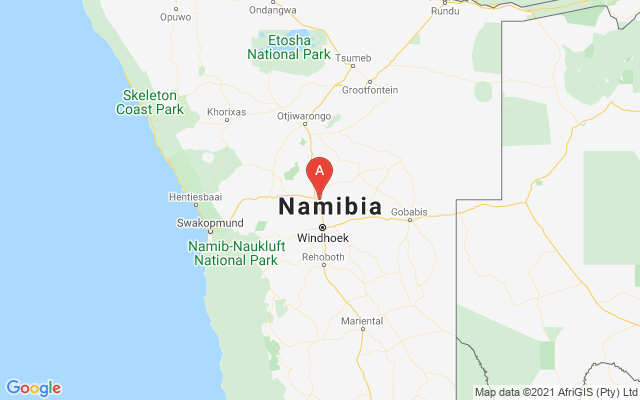
map of Namibia
Introduction: NAMIBIA
South Africa occupied the German colony of South-West Africa during World War I and administered it as a mandate until after World War II, when it annexed the territory. In 1966 the Marxist South-West Africa People's Organization (SWAPO) guerrilla group launched a war of independence for the area that was soon named Namibia, but it was not until 1988 that South Africa agreed to end its administration in accordance with a UN peace plan for the entire region. Namibia won its independence in 1990 and has been governed by SWAPO since. Hifikepunye POHAMBA was elected president in November 2004 in a landslide victory replacing Sam NUJOMA who led the country during its first 14 years of self rule.
GEOGRAPHY
Country name: conventional long form: Republic of Namibia
conventional short form: Namibia
former: German Southwest Africa, South-West Africa
Capital: Windhoek
Location: Southern Africa, bordering the South Atlantic Ocean, between Angola and South Africa
Geographic Coordinates: 22 00 S, 17 00 E
Area: total: 825,418 sq km
land: 825,418 sq km
water: 0 sq km
Area Comparative: slightly more than half the size of Alaska
Land Boundaries: total: 3,936 km
border countries: Angola 1,376 km, Botswana 1,360 km, South Africa 967 km, Zambia 233 km
Coastline: 1,572 km
Maritime Claims: territorial sea: 12 nm
contiguous zone: 24 nm
exclusive economic zone: 200 nm
Climate: desert; hot, dry; rainfall sparse and erratic
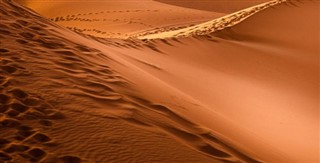
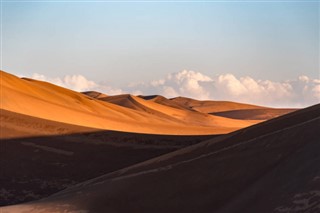
Terrain: mostly high plateau; Namib Desert along coast; Kalahari Desert in east
Elavation Extremes: lowest point: Atlantic Ocean 0 m
highest point: Konigstein 2,606 m
Natural Resources: diamonds, copper, uranium, gold, lead, tin, lithium, cadmium, zinc, salt, hydropower, fish
note: suspected deposits of oil, coal, and iron ore
GOVERNEMENT
Governement Type: republic
Administratives Divisions: 13 regions; Caprivi, Erongo, Hardap, Karas, Khomas, Kunene, Ohangwena, Okavango, Omaheke, Omusati, Oshana, Oshikoto, Otjozondjupa
Independence 21 March 1990 (from South African mandate)
National Holiday: Independence Day, 21 March (1990)
Constitution: ratified 9 February 1990; effective 12 March 1990
Legal System; based on Roman-Dutch law and 1990 constitution
Suffrage 18 years of age; universal
Executive Branch: chief of state: President Hifikepunye POHAMBA (since 15 November 2004)
head of government: Prime Minister Theo-Ben GURIRAB (since 28 August 2002)
cabinet: Cabinet appointed by the president from among the members of the National Assembly
elections: president elected by popular vote for a five-year term; election last held 15 November 2004 (next to be held November 2009)
election results: Hifikepunye POHAMBA elected president; percent of vote - NA%
Legislative Branch: bicameral legislature consists of the National Council (26 seats; two members are chosen from each regional council to serve six-year terms) and the National Assembly (72 seats; members are elected by popular vote to serve five-year terms)
elections: National Council - elections for regional councils, to determine members of the National Council, held 15-16 November 2004 (next to be held November 2009); National Assembly - last held 15-16 November 2004 (next to be held November 2009)
election results: National Council - percent of vote by party - NA%; seats by party - NA; National Assembly - percent of vote by party - NA%; seats by party - SWAPO 55, COD 5, DTA 4, UDF 3, MAG 1, other 4
note: the National Council is primarily an advisory body
Judicial Branch: Supreme Court (judges appointed by the president on the recommendation of the Judicial Service Commission)
Political parties and Leaders: Congress of Democrats or COD [Ben ULENGA]; Democratic Turnhalle Alliance of Namibia or DTA [Katuutire KAURA, president]; Monitor Action Group or MAG [Kosie PRETORIUS]; South West Africa People's Organization or SWAPO [Sam Shafishuna NUJOMA]; United Democratic Front or UDF [Justus GAROEB]
PEOPLE
Population: 2,030,692
note: estimates for this country explicitly take into account the effects of excess mortality due to AIDS; this can result in lower life expectancy, higher infant mortality and death rates, lower population and growth rates, and changes in the distribution of population by age and sex than would otherwise be expected (July 2005 est.)
Age structure: 0-14 years: 38.7% (male 396,247/female 389,543)
15-64 years: 57.7% (male 586,900/female 584,779)
65 years and over: 3.6% (male 33,524/female 39,699) (2005 est.)
Median age: total: 19.79 years
male: 19.63 years
female: 19.94 years (2005 est.)
Nationality: noun: Namibian(s)
adjective: Namibian
Ethnic groups: black 87.5%, white 6%, mixed 6.5%
note: about 50% of the population belong to the Ovambo tribe and 9% to the Kavangos tribe; other ethnic groups are: Herero 7%, Damara 7%, Nama 5%, Caprivian 4%, Bushmen 3%, Baster 2%, Tswana 0.5%
Religions: Christian 80% to 90% (Lutheran 50% at least), indigenous beliefs 10% to 20%
Languages: English 7% (official), Afrikaans common language of most of the population and about 60% of the white population, German 32%, indigenous languages: Oshivambo, Herero, Nama
COMUNICATIONS
Telephones - main lines in use: 127,400 (2003)
Telephones - mobile cellular: 223,700 (2003)
Telephone system: general assessment: good system; about 6 telephones for each 100 persons
domestic: good urban services; fair rural service; microwave radio relay links major towns; connections to other populated places are by open wire; 100% digital
international: country code - 264; fiber-optic cable to South Africa, microwave radio relay link to Botswana, direct links to other neighboring countries; connected to Africa ONE and South African Far East (SAFE) submarine cables through South Africa; satellite earth stations - 4 Intelsat (2002)
Radio broadcast stations: AM 2, FM 39, shortwave 4 (2001)
Television broadcast stations: 8 (plus about 20 low-power repeaters) (1997)
Internet country code: .na
Internet hosts: 3,164 (2003)
Internet users: 65,000 (2003)
TRANSPORT
Railways: total: 2,382 km
narrow gauge: 2,382 km 1.067-m gauge (2003)
Highways: total: 42,237 km
paved: 5,406 km
unpaved: 36,831 km (2002)
Waterways:  
Pipelines:  
Ports and harbors: Luderitz, Walvis Bay
Merchant marine: total: 1 ship (1,000 GRT or over) 2,265 GRT/3,605 DWT
by type: cargo 1 (2005)
Airports: 136 (2004 est.)
Airports - with paved runways: total: 21
over 3,047 m: 2
2,438 to 3,047 m: 2
1,524 to 2,437 m: 13
914 to 1,523 m: 4 (2004 est.)
Airports - with unpaved runways: total: 115
2,438 to 3,047 m: 2
1,524 to 2,437 m: 22
914 to 1,523 m: 71
under 914 m: 20 (2004 est.)
Heliports:  
 
 
Copyright © 1blueplanet.com