Notice: SSI.php was unable to load a session! This may cause problems with logout and other functions - please make sure SSI.php is included before *anything* else in all your scripts! in /home/blurwqr/public_html/community/SSI.php on line 158
1BluePlanet Lithuania
lithuania flag of Lithuania
Print this pages
Email to a friend Add to Favorites
 
 
Welcome, Guest. Please login or register here


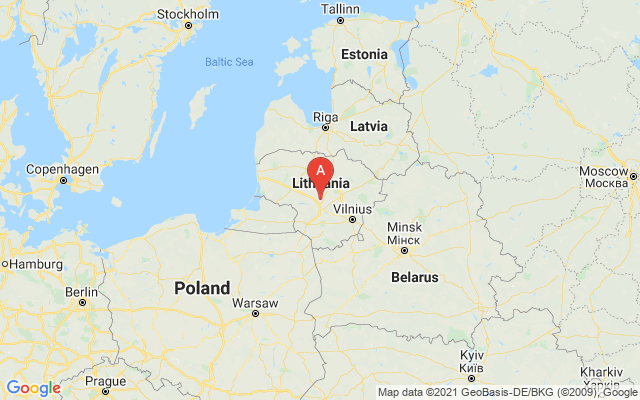
map of Lithuania
Introduction: LITHUANIA
Independent between the two World Wars, Lithuania was annexed by the USSR in 1940. On 11 March 1990, Lithuania became the first of the Soviet republics to declare its independence, but Moscow did not recognize this proclamation until September of 1991 (following the abortive coup in Moscow). The last Russian troops withdrew in 1993. Lithuania subsequently restructured its economy for integration into Western European institutions; it joined both NATO and the EU in the spring of 2004.
GEOGRAPHY
Country name: conventional long form: Republic of Lithuania
conventional short form: Lithuania
local long form: Lietuvos Respublika
local short form: Lietuva
former: Lithuanian Soviet Socialist Republic
Capital: Vilnius
Location: Eastern Europe, bordering the Baltic Sea, between Latvia and Russia
Geographic Coordinates: 56 00 N, 24 00 E
Area: total: 65,200 sq km
land: NA sq km
water: NA sq km
Area Comparative: slightly larger than West Virginia
Land Boundaries: total: 1,273 km
border countries: Belarus 502 km, Latvia 453 km, Poland 91 km, Russia (Kaliningrad) 227 km
Coastline: 99 km
Maritime Claims: territorial sea: 12 nm
Climate: transitional, between maritime and continental; wet, moderate winters and summers
Terrain: lowland, many scattered small lakes, fertile soil
Elavation Extremes: lowest point: Baltic Sea 0 m
highest point: Juozapines/Kalnas 292 m
Natural Resources: peat, arable land
GOVERNEMENT
Governement Type: parliamentary democracy
Administratives Divisions: 10 counties (apskritys, singular - apskritis); Alytaus, Kauno, Klaipedos, Marijampoles, Panevezio, Siauliu, Taurages, Telsiu, Utenos, Vilniaus
Independence 11 March 1990 (independence declared from Soviet Union); 6 September 1991 (Soviet Union recognizes Lithuania's independence)
National Holiday: Independence Day, 16 February (1918); note - 16 February 1918 is the date Lithuania declared its independence from Soviet Russia and established its statehood; 11 March 1990 is the date it declared its independence from the Soviet Union
Constitution: adopted 25 October 1992
Legal System; adopted 25 October 1992based on civil law system; legislative acts can be appealed to the constitutional court
Suffrage 18 years of age; universal
Executive Branch: chief of state: President Valdas ADAMKUS (since 12 July 2004)
head of government: Premier Algirdas Mykolas BRAZAUSKAS (since 3 July 2001)
cabinet: Council of Ministers appointed by the president on the nomination of the premier
elections: president elected by popular vote for a five-year term; election last held 13 June 2004 and 27 June 2004 (next to be held June 2009); premier appointed by the president on the approval of the Parliament
election results: Valdas ADAMKUS elected president; percent of vote - Valdas ADAMKUS 52.2%, Kazimiera PRUNSKIENE 47.8%
Legislative Branch: unicameral Parliament or Seimas (141 seats, 71 members are directly elected by popular vote, 70 are elected by proportional representation; members serve four-year terms)
elections: last held 10 and 24 October 2004 (next to be held October 2008)
election results: percent of vote by party - Labor 28.6%, Working for Lithuania (Social Democrats and Social Liberals) 20.7%, Homeland Union (Conservatives) 14.6%, For Order and Justice (Liberal Democrats and Lithuanian People's Union) 11.4%, Liberal and Center Union 9.1%, Union of Farmers and New Democracy 6.6%; seats by faction - Labor 39, Homeland Union 25, Social Democrats 20, Liberal and Center Union 18, Social Liberals 11, Union of Farmers and New Democracy Parties 10, Liberal Democrats 10, Electoral Action 2, independents 6
Judicial Branch: Constitutional Court; Supreme Court; Court of Appeal; judges for all courts appointed by the President
Political parties and Leaders: Electoral Action of Lithuanian Poles [Valdemar TOMASZEVSKI, chairman]; Homeland Union/Conservative Party or TS [Andrius KUBILIUS, chairman]; Labor Party [Viktor USPASKICH, chairman]; Liberal and Center Union [Arturas ZUOKAS, chairman]; Liberal Democratic Party [Valentinas MAZURONIS, chairman]; Lithuanian Christian Democrats or LKD [Valentinas STUNDYS, chairman]; Lithuanian People's Union for a Fair Lithuania; Lithuanian Social Democratic Coalition [Algirdas BRAZAUSKAS, chairman] consists of the Lithuanian Democratic Labor Party or LDDP and the Lithuanian Social Democratic Party or LSDP; New Democracy and Farmer's Union or VNDPS [Kazimiera PRUNSKIENE, chairman]; Social Liberals (New Union) [Arturas PAULAUSKAS, chairman]; Social Union of Christian Conservatives [Gediminas VAGNORIUS, chairman]; Young Lithuania and New Nationalists
PEOPLE
Population: 3,596,617 (July 2005 est.)
Age structure: 0-14 years: 16.1% (male 297,271/female 282,269)
15-64 years: 68.7% (male 1,206,731/female 1,264,359)
65 years and over: 15.2% (male 186,979/female 359,008) (2005 est.)
Median age: total: 37.83 years
male: 35.25 years
female: 40.46 years (2005 est.)
Nationality: noun: Lithuanian(s)
adjective: Lithuanian
Ethnic groups: Lithuanian 80.6%, Russian 8.7%, Polish 7%, Belarusian 1.6%, other 2.1%
Religions: Roman Catholic (primarily), Lutheran, Russian Orthodox, Protestant, Evangelical Christian Baptist, Muslim, Jewish
Languages: Lithuanian (official), Polish, Russian
COMUNICATIONS
Telephones - main lines in use: 824,200 (2003)
Telephones - mobile cellular: 2,169,900 (2003)
Telephone system: general assessment: inadequate, but is being modernized to provide an improved international capability and better residential access
domestic: a national, fiber-optic cable, interurban, trunk system is nearing completion; rural exchanges are being improved and expanded; mobile cellular systems are being installed; access to the Internet is available; still many unsatisfied telephone subscriber applications
international: country code - 370; landline connections to Latvia and Poland; major international connections to Denmark, Sweden, and Norway by submarine cable for further transmission by satellite
Radio broadcast stations: AM 29, FM 142, shortwave 1 (2001)
Television broadcast stations: 27
note: Lithuania has approximately 27 broadcasting stations, but may have as many as 100 transmitters, including repeater stations (2001)
Internet country code: .lt
Internet hosts: 67,769 (2004)
Internet users: 695,700 (2003)
TRANSPORT
Railways: total: 1,998 km
broad gauge: 1,807 km 1.524-m gauge (122 km electrified)
standard gauge: 22 km 1.435-m gauge
narrow gauge: 169 km 0.750-m gauge (all service suspended) (2003)
Highways: total: 77,148 km
paved: 69,202 km (including 417 km of expressways)
unpaved: 7,946 km (2002)
Waterways: 600 km (2004)
Pipelines: gas 1,696 km; oil 331 km; refined products 109 km (2004)
Ports and harbors: Butinge, Kaunas, Klaipeda
Merchant marine: total: 54 ships (1,000 GRT or over) 296,856 GRT/317,731 DWT
by type: bulk carrier 8, cargo 24, chemical tanker 1, passenger/cargo 6, petroleum tanker 1, refrigerated cargo 13, roll on/roll off 1
foreign-owned: 12 (Denmark 12)
registered in other countries: 16 (2005)
Airports: 102 (2004 est.)
Airports - with paved runways: total: 28
over 3,047 m: 4
2,438 to 3,047 m: 1
1,524 to 2,437 m: 7
914 to 1,523 m: 2
under 914 m: 14 (2003 est.)
Airports - with unpaved runways: total: 74
1,524 to 2,437 m: 2
914 to 1,523 m: 5
under 914 m: 67 (2003 est.)
Heliports:  
 
 
Copyright © 1blueplanet.com