Notice: SSI.php was unable to load a session! This may cause problems with logout and other functions - please make sure SSI.php is included before *anything* else in all your scripts! in /home/blurwqr/public_html/community/SSI.php on line 158
1BluePlanet North Korea
north korea flag of North Korea
Print this pages
Email to a friend Add to Favorites
 
 
Welcome, Guest. Please login or register here


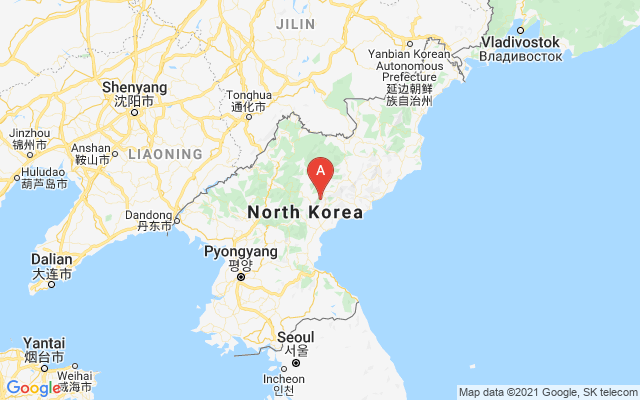
map of North Korea
Introduction: NORTH KOREA
An independent kingdom under Chinese suzerainty for most of the past millennium, Korea was occupied by Japan in 1905 following the Russo-Japanese War; five years later, Japan formally annexed the entire peninsula. Following World War II, Korea was split, with the northern half coming under Soviet-sponsored Communist domination. After failing in the Korean War (1950-53) to conquer the US-backed republic in the southern portion by force, North Korea under its founder President KIM Il Sung adopted a policy of ostensible diplomatic and economic "self-reliance" as a check against excessive Soviet or Communist Chinese influence and molded political, economic, and military policies around the core ideological objective of eventual unification of Korea under Pyongyang's control. KIM's son, the current ruler KIM Jong Il, was officially designated as KIM's future successor in 1980 and assumed a growing political and managerial role until his father's death in 1994, when he assumed full power without opposition. After decades of economic mismanagement and resource misallocation, the North since the mid-1990s has relied heavily on international food aid to feed its population while continuing to expend resources to maintain an army of about 1 million. North Korea's long-range missile development and research into nuclear, chemical, and biological weapons and massive conventional armed forces are of major concern to the international community. In December 2002, following revelations it was pursuing a nuclear weapons program based on enriched uranium in violation of a 1994 agreement with the United States to freeze and ultimately dismantle its existing plutonium-based program, North Korea expelled monitors from the International Atomic Energy Agency (IAEA), and in January 2003 declared its withdrawal from the international Non-Proliferation Treaty. In mid-2003 Pyongyang announced it had completed the reprocessing of spent nuclear fuel rods (to extract weapons-grade plutonium) and was developing a "nuclear deterrent." Since August 2003 North Korea has participated in six-party talks with the United States, China, South Korea, Japan, and Russia to resolve the stalemate over its nuclear programs.
GEOGRAPHY
Country name: conventional long form: Democratic People's Republic of Korea
conventional short form: North Korea
local long form: Choson-minjujuui-inmin-konghwaguk
local short form: none
note: the North Koreans generally use the term "Choson" to refer to their country
abbreviation: DPRK
Capital: Pyongyang
Location: Eastern Asia, northern half of the Korean Peninsula bordering the Korea Bay and the Sea of Japan, between China and South Korea
Geographic Coordinates: 40 00 N, 127 00 E
Area: total: 120,540 sq km
land: 120,410 sq km
water: 130 sq km
Area Comparative: slightly smaller than Mississippi
Land Boundaries: total: 1,673 km
border countries: China 1,416 km, South Korea 238 km, Russia 19 km
Coastline: 2,495 km
Maritime Claims: territorial sea: 12 nm
exclusive economic zone: 200 nm
note: military boundary line 50 nm in the Sea of Japan and the exclusive economic zone limit in the Yellow Sea where all foreign vessels and aircraft without permission are banned
Climate: temperate with rainfall concentrated in summer
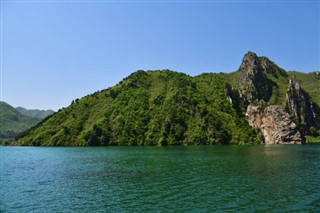
Terrain: mostly hills and mountains separated by deep, narrow valleys; coastal plains wide in west, discontinuous in east
Elavation Extremes: lowest point: Sea of Japan 0 m
highest point: Paektu-san 2,744 m
Natural Resources: coal, lead, tungsten, zinc, graphite, magnesite, iron ore, copper, gold, pyrites, salt, fluorspar, hydropower
GOVERNEMENT
Governement Type: Communist state one-man dictatorship
Administratives Divisions: 9 provinces (do, singular and plural) and 4 municipalities (si, singular and plural)
: provinces: Chagang-do (Chagang), Hamgyong-bukto (North Hamgyong), Hamgyong-namdo (South Hamgyong), Hwanghae-bukto (North Hwanghae), Hwanghae-namdo (South Hwanghae), Kangwon-do (Kangwon), P'yongan-bukto (North P'yongan), P'yongan-namdo (South P'yongan), Yanggang-do (Yanggang)
: municipalites: Kaesong-si (Kaesong), Najin Sonbong-si (Najin), Namp'o-si (Namp'o), P'yongyang-si (Pyongyang)
Independence 15 August 1945 (from Japan)
National Holiday: Founding of the Democratic People's Republic of Korea (DPRK), 9 September (1948)
Constitution: adopted 1948, completely revised 27 December 1972, revised again in April 1992 and September 1998
Legal System; based on German civil law system with Japanese influences and Communist legal theory; no judicial review of legislative acts; has not accepted compulsory ICJ jurisdiction
Suffrage 17 years of age; universal
Executive Branch: chief of state: KIM Jong Il (since July 1994); note - on 3 September 2003, rubberstamp Supreme People's Assembly (SPA) reelected KIM Jong Il Chairman of the National Defense Commission, a position accorded nation's "highest administrative authority"; SPA reelected KIM Yong Nam President of its Presidium also with responsibility of representing state and receiving diplomatic credentials; SPA appointed PAK Pong Ju Premier
head of government: Premier PAK Pong Ju (since 3 September 2003); Vice Premiers KWAK Pom Gi (since 5 September 1998), JON Sung Hun (since 3 September 2003), RO Tu Chol (since 3 September 2003)
cabinet: Cabinet (Naegak), members, except for the Minister of People's Armed Forces, are appointed by the SPA
elections: election last held in September 2003 (next to be held in September 2008)
election results: KIM Jong Il and KIM Yong Nam were only nominees for positions and ran unopposed
Legislative Branch: unicameral Supreme People's Assembly or Ch'oego Inmin Hoeui (687 seats; members elected by popular vote to serve five-year terms)
elections: last held 3 August 2003 (next to be held in August 2008)
election results: percent of vote by party - NA; seats by party - NA; ruling party approves a list of candidates who are elected without opposition; some seats are held by minor parties
Judicial Branch: Central Court (judges are elected by the Supreme People's Assembly)
Political parties and Leaders: major party - Korean Workers' Party or KWP [KIM Jong Il, general secretary]; minor parties - Chondoist Chongu Party [RYU Mi Yong, chairwoman] (under KWP control); Social Democratic Party [KIM Yong Dae, chairman] (under KWP control)
PEOPLE
Population: 22,912,177 (July 2005 est.)
Age structure: 0-14 years: 24.2% (male 2,816,844/female 2,735,478)
15-64 years: 67.9% (male 7,668,581/female 7,883,267)
65 years and over: 7.9% (male 625,819/female 1,182,188) (2005 est.)
Median age: total: 31.74 years
male: 30.47 years
female: 33 years (2005 est.)
Nationality: noun: Korean(s)
adjective: Korean
Ethnic groups: racially homogeneous; there is a small Chinese community and a few ethnic Japanese
Religions: traditionally Buddhist and Confucianist, some Christian and syncretic Chondogyo (Religion of the Heavenly Way)
note: autonomous religious activities now almost nonexistent; government-sponsored religious groups exist to provide illusion of religious freedom
Languages: Korean
COMUNICATIONS
Telephones - main lines in use: 1.1 million (2001)
Telephones - mobile cellular: NA
Telephone system: general assessment: NA
domestic: NA
international: country code - 850; satellite earth stations - 1 Intelsat (Indian Ocean) and 1 Russian (Indian Ocean region); other international connections through Moscow and Beijing
Radio broadcast stations: AM 16, FM 14, shortwave 12 (1999)
Television broadcast stations: 38 (1999)
Internet country code: .kp
Internet hosts:  
Internet users: NA
TRANSPORT
Railways: total: 5,214 km
standard gauge: 5,214 km 1.435-m gauge (3,500 km electrified) (2003)
Highways: total: 31,200 km
paved: 1,997 km
unpaved: 29,203 km (1999 est.)
Waterways: 2,250 km
note: most navigable only by small craft (2004)
Pipelines: oil 154 km (2004)
Ports and harbors: Ch'ongjin, Haeju, Hungnam (Hamhung), Kimch'aek, Kosong, Najin, Namp'o, Sinuiju, Songnim, Sonbong (formerly Unggi), Ungsang, Wonsan
Merchant marine: total: 238 ships (1,000 GRT or over) 985,108 GRT/1,389,389 DWT
by type: bulk carrier 13, cargo 191, container 2, livestock carrier 4, passenger/cargo 5, petroleum tanker 13, refrigerated cargo 5, roll on/roll off 5
foreign-owned: 52 (China 1, Denmark 2, France 1, Greece 4, Italy 1, Lebanon 4, Lithuania 1, Netherlands 1, Pakistan 2, Romania 10, Russia 2, Singapore 2, South Korea 2, Syria 9, Turkey 6, Ukraine 1, UAE 3) (2005)
Airports: 78 (2004 est.)
Airports - with paved runways: total: 35
over 3,047 m: 2
2,438 to 3,047 m: 23
1,524 to 2,437 m: 6
914 to 1,523 m: 1
under 914 m: 3 (2004 est.)
Airports - with unpaved runways: total: 43
2,438 to 3,047 m: 1
1,524 to 2,437 m: 20
914 to 1,523 m: 14
under 914 m: 8 (2004 est.)
Heliports: 19 (2004 est.)
 
 
Copyright © 1blueplanet.com