Notice: SSI.php was unable to load a session! This may cause problems with logout and other functions - please make sure SSI.php is included before *anything* else in all your scripts! in /home/blurwqr/public_html/community/SSI.php on line 158
1BluePlanet Guyana
Guyana flag of Guyana
Print this pages
Email to a friend Add to Favorites
 
 
Welcome, Guest. Please login or register here


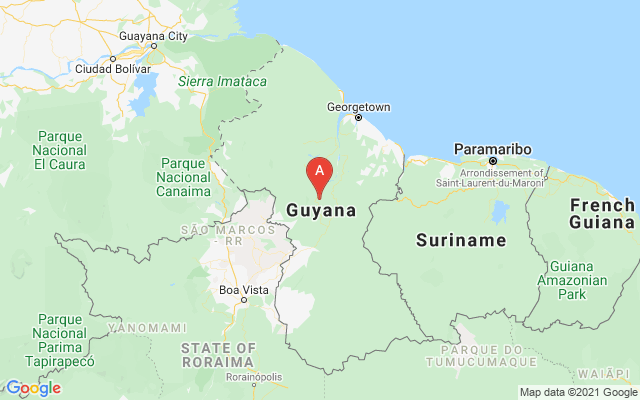
map of Guyana
Introduction: GUYANA
Originally a Dutch colony in the 17th century, by 1815 Guyana had become a British possession. The abolition of slavery led to black settlement of urban areas and the importation of indentured servants from India to work the sugar plantations. This ethnocultural divide has persisted and has led to turbulent politics. Guyana achieved independence from the UK in 1966, but until the early 1990s it was ruled mostly by socialist-oriented governments. In 1992, Cheddi JAGAN was elected president, in what is considered the country's first free and fair election since independence. Upon his death five years later, he was succeeded by his wife Janet, who resigned in 1999 due to poor health. Her successor, Bharrat JAGDEO, was reelected in 2001.
GEOGRAPHY
Country name: conventional long form: Co-operative Republic of Guyana
conventional short form: Guyana
former: British Guiana
Capital: Georgetown
Location: Northern South America, bordering the North Atlantic Ocean, between Suriname and Venezuela
Geographic Coordinates: 5 00 N, 59 00 W
Area: total: 214,970 sq km
land: 196,850 sq km
water: 18,120 sq km
Area Comparative: slightly smaller than Idaho
Land Boundaries: total: 2,462 km
border countries: Brazil 1,119 km, Suriname 600 km, Venezuela 743 km
Coastline: 459 km
Maritime Claims: territorial sea: 12 nm
exclusive economic zone: 200 nm
continental shelf: 200 nm or to the outer edge of the continental margin
Climate: tropical; hot, humid, moderated by northeast trade winds; two rainy seasons (May to mid-August, mid-November to mid-January)
Terrain: mostly rolling highlands; low coastal plain; savanna in south
Elavation Extremes: lowest point: Atlantic Ocean 0 m
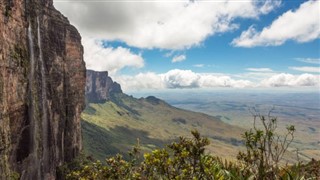
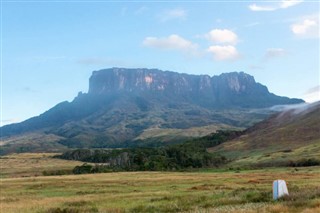
highest point: Mount Roraima 2,835 m
Natural Resources: bauxite, gold, diamonds, hardwood timber, shrimp, fish
GOVERNEMENT
Governement Type: republic within the Commonwealth
Administratives Divisions: 10 regions; Barima-Waini, Cuyuni-Mazaruni, Demerara-Mahaica, East Berbice-Corentyne, Essequibo Islands-West Demerara, Mahaica-Berbice, Pomeroon-Supenaam, Potaro-Siparuni, Upper Demerara-Berbice, Upper Takutu-Upper Essequibo
Independence 26 May 1966 (from UK)
National Holiday: Republic Day, 23 February (1970)
Constitution: 6 October 1980
Legal System; based on English common law with certain admixtures of Roman-Dutch law; has not accepted compulsory ICJ jurisdiction
Suffrage 18 years of age; universal
Executive Branch: chief of state: President Bharrat JAGDEO (since 11 August 1999); note - assumed presidency after resignation of President Janet JAGAN
head of government: Prime Minister Samuel HINDS (since December 1997)
cabinet: Cabinet of Ministers appointed by the president, responsible to the legislature
elections: president elected by the majority party in the National Assembly following legislative elections, which must be held at least every five years; elections last held 19 March 2001 (next to be held by March 2006); prime minister appointed by the president
election results: President Bharrat JAGDEO reelected; percent of legislative vote - NA%
Legislative Branch: unicameral National Assembly (68 seats, 65 elected by popular vote, 1 elected Speaker of the National Assembly, and 2 nonvoting members appointed by the president; members serve five-year terms)
elections: last held 19 March 2001 (next to be held March 2006)
election results: percent of vote by party - NA%; seats by party - PPP/C 34, PNC 27, GAP and WPA 2, ROAR 1, TUF 1
Judicial Branch: Supreme Court of Judicature; Judicial Court of Appeal; High Court
Political parties and Leaders: Alliance for Guyana or AFG (includes Guyana Labor Party or GLP and Working People's Alliance or WPA) [Rupert ROOPNARAINE]; Guyana Action Party or GAP [Paul HARDY]; Guyana Labor Party or GLP [leader NA]; People's National Congress or PNC [Robert Herman Orlando CORBIN]; People's Progressive Party/Civic or PPP/C [Bharrat JAGDEO]; Rise, Organize, and Rebuild or ROAR [Ravi DEV]; The United Force or TUF [Manzoor NADIR]; Working People's Alliance or WPA [Rupert ROOPNARAINE]
PEOPLE
Population: 765,283
note: estimates for this country explicitly take into account the effects of excess mortality due to AIDS; this can result in lower life expectancy, higher infant mortality and death rates, lower population and growth rates, and changes in the distribution of population by age and sex than would otherwise be expected (July 2005 est.)
Age structure: 0-14 years: 26.4% (male 103,054/female 99,279)
15-64 years: 68.5% (male 263,953/female 260,000)
65 years and over: 5.1% (male 16,801/female 22,196) (2005 est.)
Median age: total: 26.91 years
male: 26.44 years
female: 27.4 years (2005 est.)
Nationality: noun: Guyanese (singular and plural)
adjective: Guyanese
Ethnic groups: East Indian 50%, black 36%, Amerindian 7%, white, Chinese, and mixed 7%
Religions: Christian 50%, Hindu 35%, Muslim 10%, other 5%
Languages: English, Amerindian dialects, Creole, Hindi, Urdu
COMUNICATIONS
Telephones - main lines in use: 80,400 (2002)
Telephones - mobile cellular: 87,300 (2002)
Telephone system: general assessment: fair system for long-distance service
domestic: microwave radio relay network for trunk lines
international: country code - 592; tropospheric scatter to Trinidad; satellite earth station - 1 Intelsat (Atlantic Ocean)
Radio broadcast stations: AM 3, FM 3, shortwave 1 (1998)
Television broadcast stations: 3 (one public station; two private stations which relay US satellite services) (1997)
Internet country code: .gy
Internet hosts: 613 (2003)
Internet users: 125,000 (2002)
TRANSPORT
Railways: total: 187 km
standard gauge: 139 km 1.435-m gauge
narrow gauge: 48 km 0.914-m gauge
note: all dedicated to ore transport (2001 est.)
Highways: total: 7,970 km
paved: 590 km
unpaved: 7,380 km (1999 est.)
Waterways: 1,077 km
note: Berbice, Demerara, and Essequibo rivers are navigable by oceangoing vessels for 150 km, 100 km, and 80 km respectively (2004)
Pipelines:  
Ports and harbors: Bartica, Georgetown, Linden, New Amsterdam, Parika
Merchant marine: total: 6 ships (1,000 GRT or over) 7,475 GRT/8,758 DWT
by type: cargo 5, refrigerated cargo 1
registered in other countries: 3 (2005)
Airports: 49 (2004 est.)
Airports - with paved runways: total: 8
1,524 to 2,437 m: 3
under 914 m: 5 (2004 est.)
Airports - with unpaved runways: total: 41
1,524 to 2,437 m: 1
914 to 1,523 m: 8
under 914 m: 32 (2004 est.)
Heliports:  
 
 
Copyright © 1blueplanet.com