| GEOGRAPHY |
| Country name: |
conventional long form: State of Eritrea
conventional short form: Eritrea
local long form: Hagere Ertra
local short form: Ertra
former: Eritrea Autonomous Region in Ethiopia |
| Capital: |
Asmara |
| Location: |
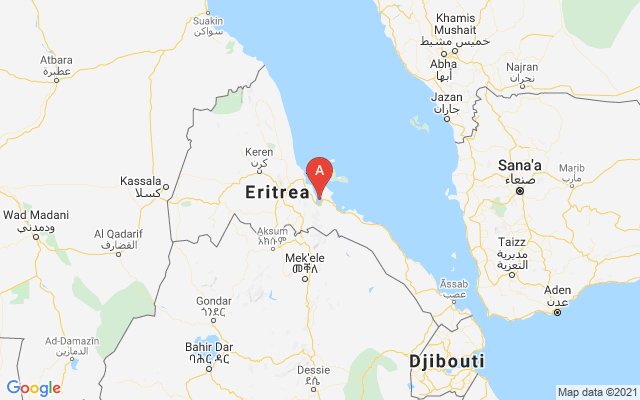
Eastern Africa, bordering the Red Sea, between Djibouti and Sudan |
| Geographic
Coordinates: |
15 00 N, 39 00 E |
| Area: |
total: 121,320 sq km
land: 121,320 sq km
water: 0 sq km |
| Area
Comparative: |
slightly larger than Pennsylvania |
| Land
Boundaries: |
total: 1,626 km
border countries: Djibouti 109 km, Ethiopia 912 km, Sudan 605 km |
| Coastline: |
2,234 km total; mainland on Red Sea 1,151 km, islands in Red Sea 1,083 km |
| Maritime
Claims: |
territorial sea: 12 nm |
| Climate: |
hot, dry desert strip along Red Sea coast; cooler and wetter in the central highlands (up to 61 cm of rainfall annually); semiarid in western hills and lowlands; rainfall heaviest during June-September except in coastal desert |
| Terrain: |
dominated by extension of Ethiopian north-south trending highlands, descending on the east to a coastal desert plain, on the northwest to hilly terrain and on the southwest to flat-to-rolling plains |
| Elavation
Extremes: |
lowest point: near Kulul within the Denakil depression -75 m
highest point: Soira 3,018 m |
| Natural
Resources: |
gold, potash, zinc, copper, salt, possibly oil and natural gas, fish |
| GOVERNEMENT |
| Governement
Type: |
transitional government
note: following a successful referendum on independence for the Autonomous Region of Eritrea on 23-25 April 1993, a National Assembly, composed entirely of the People's Front for Democracy and Justice or PFDJ, was established as a transitional legislature; a Constitutional Commission was also established to draft a constitution; ISAIAS Afworki was elected president by the transitional legislature; the constitution, ratified in May 1997, did not enter into effect, pending parliamentary and presidential elections; parliamentary elections had been scheduled in December 2001, but were postponed indefinitely; currently the sole legal party is the People's Front for Democracy and Justice (PFDJ) |
| Administratives
Divisions: |
6 regions (zobatat, singular - zoba); Anseba, Debub, Debubawi K'eyih Bahri, Gash Barka, Ma'akel, Semenawi Keyih Bahri |
| Independence |
24 May 1993 (from Ethiopia) |
| National
Holiday: |
Independence Day, 24 May (1993) |
| Constitution: |
the transitional constitution, decreed on 19 May 1993, was replaced by a new constitution adopted on 23 May 1997, but not yet implemented |
| Legal
System; |
primary basis is the Ethiopian legal code of 1957, with revisions; new civil, commercial, and penal codes have not yet been promulgated; also relies on customary and post-independence-enacted laws and, for civil cases involving Muslims, Sharia law |
| Suffrage |
18 years of age; universal |
| Executive
Branch: |
chief of state: President ISAIAS Afworki (since 8 June 1993); note - the president is both the chief of state and head of government and is head of the State Council and National Assembly
head of government: President ISAIAS Afworki (since 8 June 1993); note - the president is both the chief of state and head of government and is head of the State Council and National Assembly
cabinet: State Council is the collective executive authority; members appointed by the president
elections: president elected by the National Assembly; election last held 8 June 1993 (next election date uncertain as the National Assembly did not hold a presidential election in December 2001 as anticipated)
election results: ISAIAS Afworki elected president; percent of National Assembly vote - ISAIAS Afworki 95% |
| Legislative
Branch: |
unicameral National Assembly (150 seats; term limits not established)
elections: in May 1997, following the adoption of the new constitution, 75 members of the PFDJ Central Committee (the old Central Committee of the EPLF), 60 members of the 527-member Constituent Assembly, that had been established in 1997 to discuss and ratify the new constitution, and 15 representatives of Eritreans living abroad were formed into a Transitional National Assembly to serve as the country's legislative body until countrywide elections to a National Assembly were held; although only 75 of 150 members of the Transitional National Assembly were elected, the constitution stipulates that once past the transition stage, all members of the National Assembly will be elected by secret ballot of all eligible voters; National Assembly elections scheduled for December 2001 were postponed indefinitely |
| Judicial
Branch: |
High Court - regional, subregional, and village courts; also have military and special courts |
| Political
parties and Leaders: |
People's Front for Democracy and Justice or PFDJ, the only party recognized by the government [ISAIAS Afworki]; note - a National Assembly committee drafted a law on political parties in January 2001, but the full National Assembly has not yet debated or voted on it |
| PEOPLE |
| Population: |
4,561,599 (July 2005 est.) |
| Age structure: |
0-14 years: 44.8% (male 1,023,898/female 1,019,389)
15-64 years: 51.9% (male 1,170,823/female 1,194,741)
65 years and over: 3.3% (male 74,312/female 78,436) (2005 est.) |
| Median age: |
total: 17.54 years
male: 17.35 years
female: 17.73 years (2005 est.) |
| Nationality: |
noun: Eritrean(s)
adjective: Eritrean |
| Ethnic groups: |
ethnic Tigrinya 50%, Tigre and Kunama 40%, Afar 4%, Saho (Red Sea coast dwellers) 3%, other 3% |
| Religions: |
Muslim, Coptic Christian, Roman Catholic, Protestant |
| Languages: |
Afar, Arabic, Tigre and Kunama, Tigrinya, other Cushitic languages |
| COMUNICATIONS |
| Telephones - main
lines in use: |
38,100 (2003) |
| Telephones - mobile
cellular: |
NA |
| Telephone system: |
general assessment: inadequate
domestic: very inadequate; most telephones are in Asmara; government is seeking international tenders to improve the system (2002)
international: country code - 291; note - international connections exist |
| Radio broadcast
stations: |
AM 2, FM NA, shortwave 2 (2000) |
| Television broadcast
stations: |
1 (2000) |
| Internet country
code: |
.er |
| Internet hosts: |
1,047 (2004) |
| Internet users: |
9,500 (2003) |
| TRANSPORT |
| Railways: |
total: 306 km
narrow gauge: 306 km 0.950-m gauge
note: railway is being rebuilt; 117 km open (2003) |
| Highways: |
total: 4,010 km
paved: 874 km
unpaved: 3,136 km (1999 est.) |
| Waterways: |
|
| Pipelines: |
|
| Ports and harbors: |
Assab (Aseb), Massawa (Mits'iwa) |
| Merchant marine: |
total: 6 ships (1,000 GRT or over) 16,069 GRT/19,549 DWT
by type: cargo 3, liquefied gas 1, petroleum tanker 1, roll on/roll off 1
registered in other countries: 1 (2005) |
| Airports: |
17 (2004 est.) |
| Airports - with
paved runways: |
total: 4
over 3,047 m: 2
2,438 to 3,047 m: 2 (2004 est.) |
| Airports - with
unpaved runways: |
total: 13
over 3,047 m: 1
2,438 to 3,047 m: 1
1,524 to 2,437 m: 5
914 to 1,523 m: 4
under 914 m: 2 (2004 est.) |
| Heliports: |
|