Notice: SSI.php was unable to load a session! This may cause problems with logout and other functions - please make sure SSI.php is included before *anything* else in all your scripts! in /home/blurwqr/public_html/community/SSI.php on line 158
1BluePlanet East Timor
east timor flag of East Timor
Print this pages
Email to a friend Add to Favorites
 
 
Welcome, Guest. Please login or register here


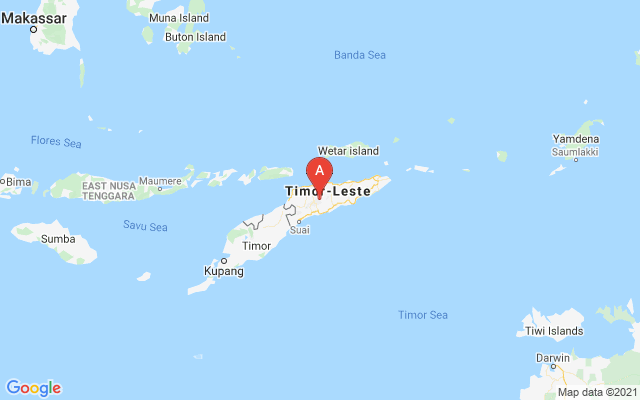
map of East Timor
Introduction: EAST TIMOR
The Portuguese began to trade with the island of Timor in the early 16th century and colonized it in mid-century. Skirmishing with the Dutch in the region eventually resulted in an 1859 treaty in which Portugal ceded the western portion of the island. Imperial Japan occupied East Timor during 1942-1945, but Portugal resumed colonial authority after the Japanese defeat in World War II. East Timor declared itself independent from Portugal on 28 November 1975 and was invaded and occupied by Indonesian forces nine days later. It was incorporated into Indonesia in July 1976 as the province of East Timor. An unsuccessful campaign of pacification followed over the next two decades, during which an estimated 100,000 to 250,000 individuals lost their lives. On 30 August 1999, in a UN-supervised popular referendum, an overwhelming majority of the people of East Timor voted for independence from Indonesia. Between the referendum and the arrival of a multinational peacekeeping force in late September 1999, anti-independence Timorese militias - organized and supported by the Indonesian military - commenced a large-scale, scorched-earth campaign of retribution. The militias killed approximately 1,300 Timorese and forcibly pushed 300,000 people into West Timor as refugees. The majority of the country's infrastructure, including homes, irrigation systems, water supply systems, and schools, and nearly 100% of the country's electrical grid were destroyed. On 20 September 1999 the Australian-led peacekeeping troops of the International Force for East Timor (INTERFET) deployed to the country and brought the violence to an end. On 20 May 2002, East Timor was internationally recognized as an independent state.
GEOGRAPHY
Country name: conventional long form: Democratic Republic of Timor-Leste
conventional short form: East Timor
local long form: Republika Demokratika Timor Lorosa'e [Tetum]; Republica Democratica de Timor-Leste [Portuguese]
local short form: Timor Lorosa'e [Tetum]; Timor-Leste [Portuguese]
former: Portuguese Timor
Capital: Dili
Location: Southeastern Asia, northwest of Australia in the Lesser Sunda Islands at the eastern end of the Indonesian archipelago; note - East Timor includes the eastern half of the island of Timor, the Oecussi (Ambeno) region on the northwest portion of the island of Timor, and the islands of Pulau Atauro and Pulau Jaco
Geographic Coordinates: 8 50 S, 125 55 E
Area: total: 15,007 sq km
land: NA
water: NA
Area Comparative: slightly larger than Connecticut
Land Boundaries: total: 228 km
border countries: Indonesia 228 km
Coastline: 706 km
Maritime Claims: territorial sea: NA
exclusive economic zone: NA
continental shelf: NA
exclusive fishing zone: NA
Climate: tropical; hot, humid; distinct rainy and dry seasons
Terrain: mountainous
Elavation Extremes: lowest point: Timor Sea, Savu Sea, and Banda Sea 0 m
highest point: Foho Tatamailau 2,963 m
Natural Resources: gold, petroleum, natural gas, manganese, marble
GOVERNEMENT
Governement Type: Republic
Administratives Divisions: 13 administrative districts; Aileu, Ainaro, Baucau, Bobonaro (Maliana), Cova-Lima (Suai), Dili, Ermera, Lautem (Los Palos), Liquica, Manatuto, Manufahi (Same), Oecussi (Ambeno), Viqueque
Independence 28 November 1975 (date of proclamation of independence from Portugal); note - 20 May 2002 is the official date of international recognition of East Timor's independence from Indonesia
National Holiday: Independence Day, 28 November (1975)
Constitution: 22 March 2002 (based on the Portuguese model)
Legal System; UN-drafted legal system based on Indonesian law remains in place but will be replaced by civil and penal codes based on Portuguese law (2004)
Suffrage 17 years of age; universal
Executive Branch: chief of state: President Kay Rala Xanana GUSMAO (since 20 May 2002); note - the president plays a largely symbolic role but is able to veto some legislation; he formerly used the name Jose Alexandre GUSMAO
head of government: Prime Minister Mari Bin Amude ALKATIRI (since 20 May 2002)
cabinet: Council of Ministers
elections: president elected by popular vote for a five-year term; election last held 14 April 2002 (next to be held in April 2007); after the first legislative elections, the leader of the majority party was appointed prime minister by the president, suggesting a precedent for the future
election results: Kay Rala Xanana GUSMAO elected president; percent of vote - Kay Rala Xanana GUSMAO 82.7%, Francisco Xavier do AMARAL 17.3%
Legislative Branch: unicameral National Parliament (number of seats can vary, minimum requirement of 52 and a maximum of 65 seats; members elected by popular vote to serve five-year terms); note - for its first term of office, the National Parliament is comprised of 88 members on an exceptional basis
elections: (next to be held August 2006); direct elections for national parliament were never held; elected delegates to the national convention named themselves legislators instead of having elections; hence the exceptional numbers for this term of the national parliament.
election results: percent of vote by party - FRETILIN 57.37%, PD 8.72%, PSD 8.18%, ASDT 7.84%, UDT 2.36%, PNT 2.21%, KOTA 2.13%, PPT 2.01%, PDC 1.98%, PST 1.78%, independents/other 5.42%; seats by party - FRETILIN 55, PD 7, PSD 6, ASDT 6, PDC 2, UDT 2, KOTA 2, PNT 2, PPT 2, UDC/PDC 1, PST 1, PL 1, independent 1
Judicial Branch: Supreme Court of Justice - constitution calls for one judge to be appointed by National Parliament and rest appointed by Superior Council for Judiciary; note - until Supreme Court is established, Court of Appeals is highest court
Political parties and Leaders: Associacao Social-Democrata Timorense or ASDT [Francisco Xavier do AMARAL]; Christian Democratic Party of Timor or PDC [Antonio XIMENES]; Christian Democratic Union of Timor or UDC [Vicente da Silva GUTERRES]; Democratic Party or PD [Fernando de ARAUJO]; Liberal Party or PL [leader NA]; Maubere Democratic Party or PDM [leader NA]; People's Party of Timor or PPT [Jacob XAVIER]; Revolutionary Front of Independent East Timor or FRETILIN [Lu OLO]; Social Democrat Party of East Timor or PSD [Mario CARRASCALAO]; Socialist Party of Timor or PST [leader Avelino COELHO]; Sons of the Mountain Warriors (also known as Association of Timorese Heroes) or KOTA [Clementino dos Reis AMARAL]; Timor Democratic Union or UDT [Joao CARRASCALAO]; Timor Labor Party or PTT [Paulo Freitas DA SILVA]; Timorese Nationalist Party or PNT [Abilio ARAUJO]; Timorese Popular Democratic Association or APODETI [Frederico Almeida-Santos DA COSTA]
PEOPLE
Population: 1,040,880
note: other estimates range as low as 800,000 (July 2005 est.)
Age structure: 0-14 years: 37.1% (male 196,108/female 189,753)
15-64 years: 59.9% (male 318,173/female 305,479)
65 years and over: 3% (male 15,353/female 16,014) (2005 est.)
Median age: total: 20.41 years
male: 20.46 years
female: 20.35 years (2005 est.)
Nationality: noun: Timorese
adjective: Timorese
Ethnic groups: Austronesian (Malayo-Polynesian), Papuan, small Chinese minority
Religions: Roman Catholic 90%, Muslim 4%, Protestant 3%, Hindu 0.5%, Buddhist, Animist (1992 est.)
Languages: Tetum (official), Portuguese (official), Indonesian, English
note: there are about 16 indigenous languages; Tetum, Galole, Mambae, and Kemak are spoken by significant numbers of people
COMUNICATIONS
Telephones - main lines in use: NA
Telephones - mobile cellular: NA
Telephone system: NA
Radio broadcast stations: AM NA, FM NA, shortwave NA
Television broadcast stations: NA
Internet country code: .tp
Internet hosts:  
Internet users: NA
TRANSPORT
Railways:  
Highways: total: 3,800 km
paved: 428 km
unpaved: 3,372 km (1995)
Waterways:  
Pipelines:  
Ports and harbors: NA
Merchant marine:  
Airports: 8 (2004 est.)
Airports - with paved runways: total: 3
2,438 to 3,047 m: 1
1,524 to 2,437 m: 1
914 to 1,523 m: 1 (2004 est.)
Airports - with unpaved runways: total: 5
914 to 1,523 m: 3
under 914 m: 2 (2004 est.)
Heliports: 1 (2004 est.)
 
 
Copyright © 1blueplanet.com