cote d' ivoire flag of Cote d'Ivoire
Print this pages
Email to a friend Add to Favorites
 
 
Welcome, Guest. Please login or register here


of Cote d'Ivoire
Introduction: COTE D'IVOIRE
Close ties to France since independence in 1960, the development of cocoa production for export, and foreign investment made Cote d'Ivoire one of the most prosperous of the tropical African states, but did not protect it from political turmoil. On 25 December 1999, a military coup - the first ever in Cote d'Ivoire's history - overthrew the government led by President Henri Konan BEDIE. Junta leader Robert GUEI held elections in late 2000, but excluded prominent opposition leader Alassane OUATTARA, blatantly rigged the polling results, and declared himself winner. Popular protest forced GUEI to step aside and brought runner-up Laurent GBAGBO into power. Ivorian dissidents and disaffected members of the military launched a failed coup attempt in September 2002. Rebel forces claimed the northern half of the country and in January 2003 were granted ministerial positions in a unity government under the auspices of the Linas-Marcoussis Peace Accord. President GBAGBO and rebel forces resumed implementation of the peace accord in December 2003 after a three-month stalemate, but issues that sparked the civil war, such as land reform and grounds for nationality remain unresolved. The central government has yet to exert control over the northern regions and tensions remain high between GBAGBO and rebel leaders. Several thousand French and West African troops remain in Cote d'Ivoire to maintain peace and facilitate the disarmament, demobilization, and rehabilitation process.
GEOGRAPHY
Country name: conventional long form: Republic of Cote d'Ivoire
conventional short form: Cote d'Ivoire
local long form: Republique de Cote d'Ivoire
local short form: Cote d'Ivoire
former: Ivory Coast
Capital: Yamoussoukro; note - although Yamoussoukro has been the official capital since 1983, Abidjan remains the commercial and administrative center; the US, like other countries, maintains its Embassy in Abidjan
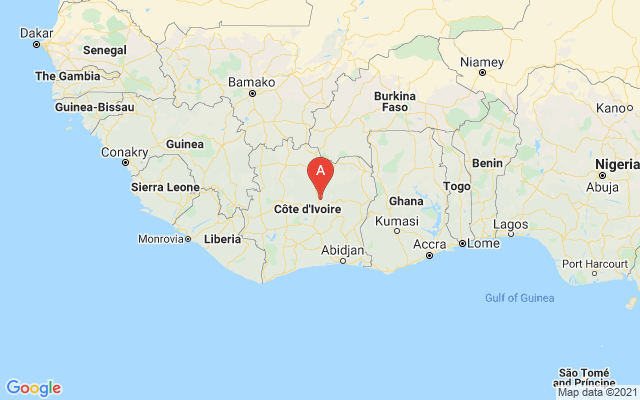
Location: Western Africa, bordering the North Atlantic Ocean, between Ghana and Liberia
Geographic Coordinates: 8 00 N, 5 00 W
Area: total: 322,460 sq km
land: 318,000 sq km
water: 4,460 sq km
Area Comparative: slightly larger than New Mexico
Land Boundaries: total: 3,110 km
border countries: Burkina Faso 584 km, Ghana 668 km, Guinea 610 km, Liberia 716 km, Mali 532 km
Coastline: 515 km
Maritime Claims: territorial sea: 12 nm
exclusive economic zone: 200 nm
continental shelf: 200 nm
Climate: tropical along coast, semiarid in far north; three seasons - warm and dry (November to March), hot and dry (March to May), hot and wet (June to October)
Terrain: mostly flat to undulating plains; mountains in northwest
Elavation Extremes: lowest point: Gulf of Guinea 0 m
highest point: Mont Nimba 1,752 m
Natural Resources: petroleum, natural gas, diamonds, manganese, iron ore, cobalt, bauxite, copper, gold, nickel, tantalum, silica sand, clay, cocoa beans, coffee, palm oil, hydropower
GOVERNEMENT
Governement Type: republic; multiparty presidential regime established 1960
Administratives Divisions: 19 regions; Agneby, Bafing, Bas-Sassandra, Denguele, Dix-Huit Montagnes, Fromager, Haut-Sassandra, Lacs, Lagunes, Marahoue, Moyen-Cavally, Moyen-Comoe, N'zi-Comoe, Savanes, Sud-Bandama, Sud-Comoe, Vallee du Bandama, Worodougou, Zanzan
Independence 7 August 1960 (from France)
National Holiday: Independence Day, 7 August (1960)
Constitution: a new constitution was adopted 4 August 2000
Legal System; based on French civil law system and customary law; judicial review in the Constitutional Chamber of the Supreme Court; has not accepted compulsory ICJ jurisdiction
Suffrage 18 years of age; universal
Executive Branch: chief of state: President Laurent GBAGBO (since 26 October 2000);
head of government: Prime Minister Seydou DIARRA (since 25 January 2003); note - appointed as transitional Prime Minister by President GBAGBO as part of a French brokered peace plan
cabinet: Council of Ministers appointed by the president
elections: president elected by popular vote for a five-year term; election last held 26 October 2000 (next to be held October 2005); prime minister appointed by the president
election results: Laurent GBAGBO elected president; percent of vote - Laurent GBAGBO 59.4%, Robert GUEI 32.7%, Francis WODIE 5.7%, other 2.2%
Legislative Branch: unicameral National Assembly or Assemblee Nationale (225 seats; members are elected in single- and multi-district elections by direct popular vote to serve five-year terms)
elections: elections last held 10 December 2000 with by-elections on 14 January 2001 (next to be held October 2005)
election results: percent of vote by party - NA%; seats by party - FPI 96, PDCI-RDA 94, RDR 5, PIT 4, other 2, independents 22, vacant 2
note: a Senate is scheduled to be created in the next full election in 2005
Judicial Branch: Supreme Court or Cour Supreme consists of four chambers: Judicial Chamber for criminal cases, Audit Chamber for financial cases, Constitutional Chamber for judicial review cases, and Administrative Chamber for civil cases; there is no legal limit to the number of members
Political parties and Leaders: Citizen's Democratic Union or UDCY [Eg Theodore MEL]; Democratic Party of Cote d'Ivoire-African Democratic Rally or PDCI-RDA [Henri Konan BEDIE]; Ivorian Popular Front or FPI [Laurent GBAGBO]; Ivorian Worker's Party or PIT [Francis WODIE]; Rally of the Republicans or RDR [Alassane OUATTARA]; Union for Democracy and Peace or UDPCI [Paul Akoto YAO]; over 20 smaller parties
PEOPLE
Population: 17,298,040
note: estimates for this country explicitly take into account the effects of excess mortality due to AIDS; this can result in lower life expectancy, higher infant mortality and death rates, lower population and growth rates, and changes in the distribution of population by age and sex than would otherwise be expected (July 2005 est.)
Age structure: 0-14 years: 41% (male 3,490,536/female 3,596,208)
15-64 years: 56.3% (male 4,920,726/female 4,820,326)
65 years and over: 2.7% (male 231,514/female 238,730) (2005 est.)
Median age: total: 19.05 years
male: 19.36 years
female: 18.76 years (2005 est.)
Nationality: noun: Ivoirian(s)
adjective: Ivoirian
Ethnic groups: Akan 42.1%, Voltaiques or Gur 17.6%, Northern Mandes 16.5%, Krous 11%, Southern Mandes 10%, other 2.8% (includes 130,000 Lebanese and 14,000 French) (1998)
Religions: Christian 20-30%, Muslim 35-40%, indigenous 25-40% (2001)
note: the majority of foreigners (migratory workers) are Muslim (70%) and Christian (20%)
Languages: French (official), 60 native dialects with Dioula the most widely spoken
COMUNICATIONS
Telephones - main lines in use: 328,000 (2003)
Telephones - mobile cellular: 1.236 million (2003)
Telephone system: general assessment: well developed by African standards but operating well below capacity
domestic: open-wire lines and microwave radio relay; 90% digitalized
international: country code - 225; satellite earth stations - 2 Intelsat (1 Atlantic Ocean and 1 Indian Ocean); 2 submarine cables (June 1999)
Radio broadcast stations: AM 2, FM 9, shortwave 3 (1998)
Television broadcast stations: 14 (1999)
Internet country code: .ci
Internet hosts: 3,795 (2004)
Internet users: 90,000 (2002)
TRANSPORT
Railways: total: 660 km
narrow gauge: 660 km 1.000-meter gauge
note: an additional 622 km of this railroad extends into Burkina Faso (2003)
Highways: total: 50,400 km
paved: 4,889 km
unpaved: 45,511 km (1999 est.)
Waterways: 980 km (navigable rivers, canals, and numerous coastal lagoons) (2003)
Pipelines: condensate 107 km; gas 223 km; oil 104 km (2004)
Ports and harbors: Abidjan, Aboisso, Dabou, San-Pedro
Merchant marine:  
Airports: 37 (2004 est.)
Airports - with paved runways: total: 7
over 3,047 m: 1
2,438 to 3,047 m: 2
1,524 to 2,437 m: 4 (2004 est.)
Airports - with unpaved runways: total: 30
1,524 to 2,437 m: 7
914 to 1,523 m: 15
under 914 m: 8 (2004 est.)
Heliports:  
 
 
Copyright © 1blueplanet.com