| GEOGRAPHY |
| Country name: |
conventional long
form: Democratic Republic of the Congo
conventional short form: none
local long form: Republique Democratique du Congo
local short form: none
former: Congo Free State, Belgian Congo, Congo/Leopoldville,
Congo/Kinshasa, Zaire
abbreviation: DROC |
| Capital: |
Kinshasa |
| Location: |
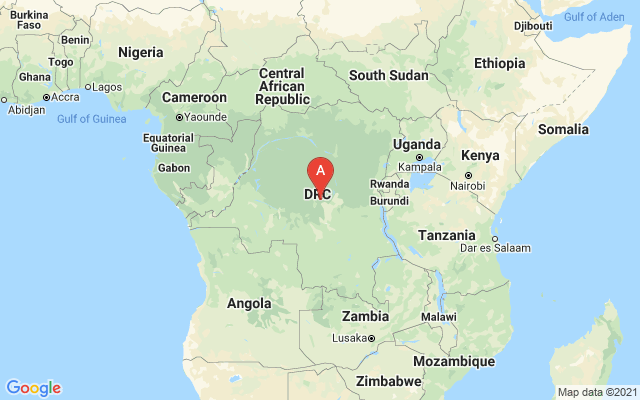
Central Africa, northeast of Angola |
| Geographic
Coordinates: |
0 00 N, 25 00 E |
| Area: |
total: 2,345,410 sq km
land: 2,267,600 sq km
water: 77,810 sq km |
| Area
Comparative: |
slightly less than one-fourth the size of the US |
| Land
Boundaries: |
total: 10,730 km
border countries: Angola 2,511 km (of which 225 km is the boundary of Angola's discontiguous Cabinda Province), Burundi 233 km, Central African Republic 1,577 km, Republic of the Congo 2,410 km, Rwanda 217 km, Sudan 628 km, Tanzania 459 km, Uganda 765 km, Zambia 1,930 km |
| Coastline: |
37 km |
| Maritime
Claims: |
territorial sea: 12 nm
exclusive economic zone: boundaries with neighbors |
| Climate: |
tropical; hot and humid in equatorial river basin; cooler and drier in southern highlands; cooler and wetter in eastern highlands; north of Equator - wet season April to October, dry season December to February; south of Equator - wet season November to March, dry season April to October |
| Terrain: |
vast central basin is a low-lying plateau; mountains in east |
| Elavation
Extremes: |
lowest point: Atlantic Ocean 0 m
highest point: Pic Marguerite on Mont Ngaliema (Mount Stanley) 5,110 m |
| Natural
Resources: |
cobalt, copper, niobium, tantalum, petroleum, industrial and gem diamonds, gold, silver, zinc, manganese, tin, uranium, coal, hydropower, timber |
| GOVERNEMENT |
| Governement
Type: |
dictatorship; presumably undergoing a transition to representative government |
| Administratives
Divisions: |
10 provinces (provinces, singular - province) and 1 city* (ville); Bandundu, Bas-Congo, Equateur, Kasai-Occidental, Kasai-Oriental, Katanga, Kinshasa*, Maniema, Nord-Kivu, Orientale, Sud-Kivu |
| Independence |
30 June 1960 (from Belgium) |
| National
Holiday: |
Independence Day, 30 June (1960) |
| Constitution: |
a new constitution was adopted 17 July 2003 |
| Legal
System; |
based on Belgian civil law system and tribal law; has not accepted compulsory ICJ jurisdiction |
| Suffrage |
18 years of age; universal and compulsory |
| Executive
Branch: |
chief of state: President Joseph KABILA (since 26 January 2001); note - following the assassination of his father, Laurent Desire KABILA, on 16 January 2001, Joseph KABILA succeeded to the presidency; the president is both the chief of state and head of government
head of government: President Joseph KABILA (since 26 January 2001); note - following the assassination of his father, Laurent Desire KABILA, on 16 January 2001, Joseph KABILA succeeded to the presidency; the president is both the chief of state and head of government
cabinet: National Executive Council, appointed by the president
elections: prior to the overthrow of MOBUTU Sese Seko, the president was elected by popular vote for a seven-year term; election last held 29 July 1984 (next was scheduled to be held in May 1997); formerly, there was also a prime minister who was elected by the High Council of the Republic; note - a Transitional Government is drafting a new constitution with free elections scheduled to be held in NA 2005
election results: MOBUTU Sese Seko Kuku Ngbendu wa Za Banga reelected president in 1984 without opposition
note: Joseph KABILA succeeded his father, Laurent Desire KABILA, following the latter's assassination in January 2001, negotiations with rebel leaders led to the establishment of a transitional government in July 2003 with free elections scheduled to be held in NA 2005 |
| Legislative
Branch: |
a 300-member Transitional Constituent Assembly established in August 2000
elections: NA; members of the Transitional Constituent Assembly were appointed by former President Laurent Desire KABILA |
| Judicial
Branch: |
Supreme Court or Cour Supreme |
| Political
parties and Leaders: |
Democratic Social Christian Party or PDSC [Andre BO-BOLIKO]; Forces for Renovation for Union and Solidarity or FONUS [Joseph OLENGHANKOY]; National Congolese Lumumbist Movement or MNC [Francois LUMUMBA]; Popular Movement of the Revolution or MPR (three factions: MPR-Fait Prive [Catherine NZUZI wa Mbombo]; MPR/Vunduawe [Felix VUNDUAWE]; MPR/Mananga [MANANGA Dintoka Mpholo]); Unified Lumumbast Party or PALU [Antoine GIZENGA]; Union for Democracy and Social Progress or UDPS [Etienne TSHISEKEDI wa Mulumba]; Union of Federalists and Independent Republicans or UFERI (two factions: UFERI [Lokambo OMOKOKO]; UFERI/OR [Adolph Kishwe MAYA]) |
| PEOPLE |
| Population: |
60,085,804
note: estimates for this country explicitly take into account the effects of excess mortality due to AIDS; this can result in lower life expectancy, higher infant mortality and death rates, lower population and growth rates, and changes in the distribution of population by age and sex than would otherwise be expected (July 2005 est.) |
| Age structure: |
0-14 years: 48.1% (male 14,513,779/female 14,396,952)
15-64 years: 49.4% (male 14,579,101/female 15,121,297)
65 years and over: 2.5% (male 597,776/female 876,099) (2005 est.) |
| Median age: |
total: 15.8 years
male: 15.4 years
female: 16.2 years (2005 est.) |
| Nationality: |
noun: Congolese (singular and plural)
adjective: Congolese or Congo |
| Ethnic groups: |
over 200 African ethnic groups of which the majority are Bantu; the four largest tribes - Mongo, Luba, Kongo (all Bantu), and the Mangbetu-Azande (Hamitic) make up about 45% of the population |
| Religions: |
Roman Catholic 50%, Protestant 20%, Kimbanguist 10%, Muslim 10%, other syncretic sects and indigenous beliefs 10% |
| Languages: |
French (official), Lingala (a lingua franca trade language), Kingwana (a dialect of Kiswahili or Swahili), Kikongo, Tshiluba |
| COMUNICATIONS |
| Telephones - main
lines in use: |
10,000 (2002) |
| Telephones - mobile
cellular: |
1 million (2003) |
| Telephone system: |
general assessment: poor
domestic: barely adequate wire and microwave radio relay service in and between urban areas; domestic satellite system with 14 earth stations
international: country code - 243; satellite earth station - 1 Intelsat (Atlantic Ocean) |
| Radio broadcast
stations: |
AM 3, FM 11, shortwave 2 (2001) |
| Television broadcast
stations: |
4 (2001) |
| Internet country
code: |
.cd |
| Internet hosts: |
153 (2003) |
| Internet users: |
50,000 (2002) |
| TRANSPORT |
| Railways: |
total: 5,138 km
narrow gauge: 3,987 km 1.067-m gauge (858 km electrified); 125 km 1.000-m gauge; 1,026 km 0.600-m gauge (2003) |
| Highways: |
total: 157,000 km (including 30 km of expressways)
paved: NA km
unpaved: NA km (1999 est.) |
| Waterways: |
15,000 km (navigation on the Congo curtailed by fighting) (2004) |
| Pipelines: |
gas 54 km; oil 71 km (2004) |
| Ports and harbors: |
Banana, Boma, Bukavu, Bumba, Goma, Kalemie, Kindu, Kinshasa, Kisangani, Matadi, Mbandaka |
| Merchant marine: |
registered in other countries: 1 |
| Airports: |
230 (2004 est.) |
| Airports - with
paved runways: |
total: 24
over 3,047 m: 4
2,438 to 3,047 m: 2
1,524 to 2,437 m: 16
914 to 1,523 m: 2 (2004 est.) |
| Airports - with
unpaved runways: |
total: 206
1,524 to 2,437 m: 17
914 to 1,523 m: 92
under 914 m: 97 (2004 est.) |
| Heliports: |
|