comoros flag c
Print this pages
Email to a friend Add to Favorites
 
 
Welcome, Guest. Please login or register here


map of Comoros
Introduction: COMOROS
Unstable Comoros has endured 19 coups or attempted coups since gaining independence from France in 1975. In 1997, the islands of Anjouan and Moheli declared their independence from Comoros. In 1999, military chief Col. AZALI seized power. He pledged to resolve the secessionist crisis through a confederal arrangement named the 2000 Fomboni Accord. In December 2001, voters approved a new constitution and presidential elections took place in the spring of 2002. Each island in the archipelago elected its own president and a new union president was sworn in on 26 May 2002.
GEOGRAPHY
Country name: conventional long form: Union of the Comoros
conventional short form: Comoros
local long form: Union des Comores
local short form: Comores
Capital: Moroni
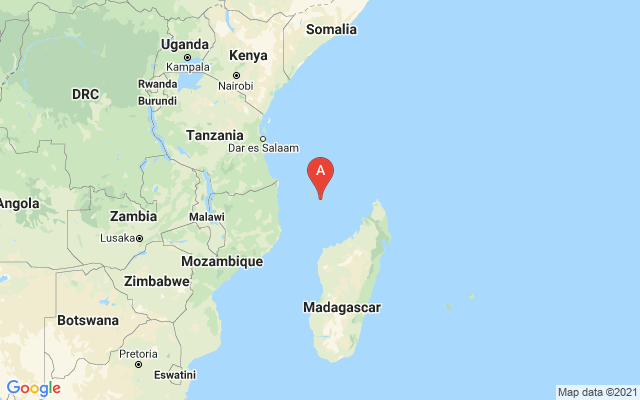
Location: Southern Africa, group of islands at the northern mouth of the Mozambique Channel, about two-thirds of the way between northern Madagascar and northern Mozambique
Geographic Coordinates: 12 10 S, 44 15 E
Area: total: 2,170 sq km
land: 2,170 sq km
water: 0 sq km
Area Comparative: slightly more than 12 times the size of Washington, DC
Land Boundaries: 0 km
Coastline: 340 km
Maritime Claims: territorial sea: 12 nm
exclusive economic zone: 200 nm
Climate: tropical marine; rainy season (November to May)
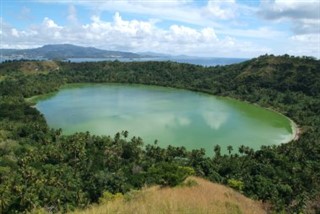
Terrain: volcanic islands, interiors vary from steep mountains to low hills
Elavation Extremes: lowest point: Indian Ocean 0 m
highest point: Le Kartala 2,360 m
Natural Resources: NEGL
GOVERNEMENT
Governement Type: independent republic
Administratives Divisions: 3 islands; Grande Comore (Njazidja), Anjouan (Nzwani), and Moheli (Mwali); note - there are also four municipalities named Domoni, Fomboni, Moroni, and Moutsamoudou
Independence 6 July 1975 (from France)
National Holiday: Independence Day, 6 July (1975)
Constitution: 23 December 2001
note: a Transitional National Unity Government (GUNT) was formed on 20 January 2002 following passage of a new constitution; the GUNT governed until the presidential elections on 14 April 2002
Legal System; French and Sharia (Islamic) law in a new consolidated code
Suffrage 18 years of age; universal
Executive Branch: chief of state: President AZALI Assoumani (since 26 May 2002); note - following a 1999 coup AZALI was appointed president; in January 2002 he resigned his position to run in the 14 April 2002 presidential elections; Prime Minister Hamada Madi BOLERO was appointed interim president until replaced again by AZALI in May 2002 when BOLERO was appointed Minister of External Defense and Territorial Security; the president is both the chief of state and the head of government
head of government: President AZALI Assoumani (since 26 May 2002); note - following a 1999 coup AZALI was appointed president; in January 2002 he resigned his position to run in the 14 April 2002 presidential elections; Prime Minister Hamada Madi BOLERO was appointed interim president until replaced again by AZALI in May 2002 when BOLERO was appointed Minister of External Defense and Territorial Security; the president is both the chief of state and the head of government
cabinet: Council of Ministers appointed by the president
elections: as defined by the 2001 constitution, the presidency rotates every four years among the elected presidents from the three main islands in the Union; election last held 14 April 2002 (next to be held April 2007); prime minister appointed by the president; note - AZALI has not appointed a Prime Minister since he was sworn into office in May 2002
election results: President AZALI Assoumani elected president with 75% of the vote
Legislative Branch: unicameral Assembly of the Union (33 seats; 15 deputies are selected by the individual islands' local assemblies and the 18 by universal suffrage; deputies serve for five years);
elections: last held 18 and 25 April 2004 (next to be held NA 2009)
election results: NA
Judicial Branch: Supreme Court or Cour Supremes (two members appointed by the president, two members elected by the Federal Assembly, one elected by the Council of each island, and others are former presidents of the republic)
Political parties and Leaders: Forces pour l'Action Republicaine or FAR [Col. Abdourazak ABDULHAMID]; Forum pour la Redressement National or FRN (alliance of 12 parties); Front Democratique or FD [Moustoifa Said CHEIKH]; Front National pour la Justice or FNJ (Islamic party in opposition) [Ahmed RACHID]; Movement des Citoyens pour la Republique or MCR [Mahamoud MRADABI]; Mouvement Populaire Anjouanais or MPA (Anjouan separatist movement) [leader NA]; Mouvement pour la Democratie et le Progress or MDP-NGDC [Abbas DJOUSSOUF]; Movement pour le Socialisme et la Democratie or MSD (splinter group of FD) [Abdou SOEFOU]; Parti Comorien pour la Democratie et le Progress or PCDP [Ali MROUDJAE]; Rassemblement National pour le Development or RND (party of the government) [Omar TAMOU, Abdoulhamid AFFRAITANE]
PEOPLE
Population: 671,247 (July 2005 est.)
Age structure: 0-14 years: 42.8% (male 144,075/female 143,175)
15-64 years: 54.2% (male 179,541/female 184,488)
65 years and over: 3% (male 9,407/female 10,561) (2005 est.)
Median age: total: 18.61 years
male: 18.35 years
female: 18.87 years (2005 est.)
Nationality: noun: Comoran(s)
adjective: Comoran
Ethnic groups: Antalote, Cafre, Makoa, Oimatsaha, Sakalava
Religions: Sunni Muslim 98%, Roman Catholic 2%
Languages: Arabic (official), French (official), Shikomoro (a blend of Swahili and Arabic)
COMUNICATIONS
Telephones - main lines in use: 13,200 (2003)
Telephones - mobile cellular: 2,000 (2003)
Telephone system: general assessment: sparse system of microwave radio relay and HF radiotelephone communication stations
domestic: HF radiotelephone communications and microwave radio relay
international: country code - 269; HF radiotelephone communications to Madagascar and Reunion
Radio broadcast stations: AM 1, FM 4, shortwave 1 (2001)
Television broadcast stations: NA
Internet country code: .km
Internet hosts: 11 (2003)
Internet users: 5,000 (2003)
TRANSPORT
Railways:  
Highways: total: 880 km
paved: 673 km
unpaved: 207 km (1999 est)
Waterways:  
Pipelines:  
Ports and harbors: Fomboni, Moroni, Moutsamoudou
Merchant marine: total: 79 ships (1,000 GRT or over) 452,801 GRT/681,343 DWT
by type: bulk carrier 9, cargo 55, chemical tanker 1, container 1, livestock carrier 1, passenger/cargo 1, petroleum tanker 5, refrigerated cargo 5, roll on/roll off 1
foreign-owned: 35 (Bulgaria 1, Germany 1, Greece 7, India 1, Jordan 1, Kenya 1, Lebanon 3, Nigeria 1, Norway 1, Pakistan 1, Philippines 1, Russia 2, Syria 3, Turkey 6, Ukraine 4, United Kingdom 1) (2005)
Airports: 4 (2004 est.)
Airports - with paved runways: total: 4
2,438 to 3,047 m: 1
914 to 1,523 m: 3 (2004 est.)
Airports - with unpaved runways:  
Heliports:  
 
 
Copyright © 1blueplanet.com