Algeria flag of Algeria
Print this pages
Email to a friend Add to Favorites
 
 
Welcome, Guest. Please login or register here


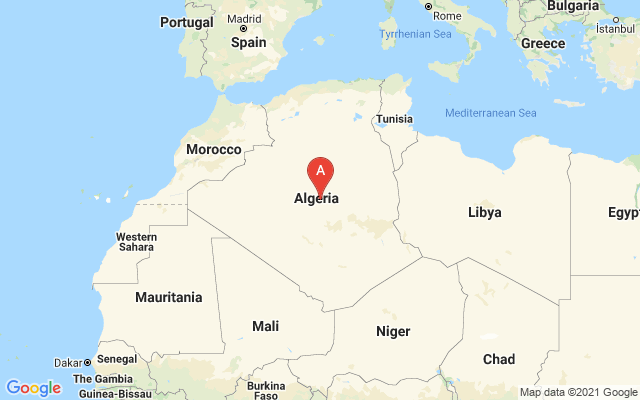
map of Algeria
Introduction: ALGERIA
After more than a century of rule by France, Algerians fought through much of the 1950s to achieve independence in 1962. Algeria's primary political party, the National Liberation Front (FLN), has dominated politics ever since. Many Algerians in the subsequent generation were not satisfied, however, and moved to counter the FLN's centrality in Algerian politics. The surprising first round success of the Islamic Salvation Front (FIS) in the December 1991 balloting spurred the Algerian army to intervene and postpone the second round of elections to prevent what the secular elite feared would be an extremist-led government from assuming power. The army began a crack down on the FIS that spurred FIS supporters to begin attacking government targets. The government later allowed elections featuring pro-government and moderate religious-based parties, but did not appease the activists who progressively widened their attacks. The fighting escalated into an insurgency, which saw intense fighting between 1992-1998 and which resulted in over 100,000 deaths - many attributed to indiscriminate massacres of villagers by extremists. The government gained the upper hand by the late-1990s and FIS's armed wing, the Islamic Salvation Army, disbanded in January 2000. However, small numbers of armed militants persist in confronting government forces and conducting ambushes and occasional attacks on villages. The army placed Abdelaziz BOUTEFLIKA in the presidency in 1999 in a fraudulent election but claimed neutrality in his 2004 landslide reelection victory. A number of longstanding problems continue to face BOUTEFLIKA in his second term, including the ethnic minority Berbers' ongoing autonomy campaign, large-scale unemployment, a shortage of housing, unreliable electrical and water supplies, government inefficiencies and corruption, and the continuing - although significantly degraded - activities of extremist militants. Algeria must also diversify its petroleum-based economy, which has yielded a large cash reserve but which has not been used to redress Algeria's many social and infrastructure problems. Algeria assumed a two-year seat on the UN Security Council in January 2004.
GEOGRAPHY
Country name: conventional long form: People's Democratic Republic of Algeria
conventional short form: Algeria
local long form: Al Jumhuriyah al Jaza'iriyah ad Dimuqratiyah ash Sha'biyah
local short form: Al Jaza'ir
Capital: Algiers
Location: Northern Africa, bordering the Mediterranean Sea, between Morocco and Tunisia
Geographic Coordinates: 28 00 N, 3 00 E
Area: total: 2,381,740 sq km
land: 2,381,740 sq km
water: 0 sq km
Area Comparative: slightly less than 3.5 times the size of Texas
Land Boundaries: total: 6,343 km
border countries: Libya 982 km, Mali 1,376 km, Mauritania 463 km, Morocco 1,559 km, Niger 956 km, Tunisia 965 km, Western Sahara 42 km
Coastline: 998 km
Maritime Claims: territorial sea: 12 nm
exclusive fishing zone: 32-52 nm
Climate: arid to semiarid; mild, wet winters with hot, dry summers along coast; drier with cold winters and hot summers on high plateau; sirocco is a hot, dust/sand-laden wind especially common in summer
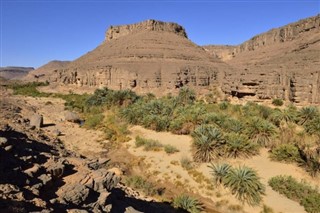
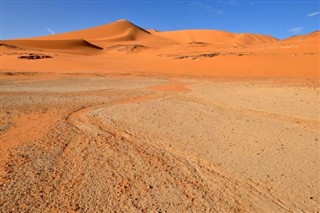
Terrain: mostly high plateau and desert; some mountains; narrow, discontinuous coastal plain
Elavation Extremes: lowest point: Chott Melrhir -40 m
highest point: Tahat 3,003 m
Natural Resources: petroleum, natural gas, iron ore, phosphates, uranium, lead, zinc
GOVERNEMENT
Governement Type: republic
Administratives Divisions: 48 provinces (wilayas, singular - wilaya); Adrar, Ain Defla, Ain Temouchent, Alger, Annaba, Batna, Bechar, Bejaia, Biskra, Blida, Bordj Bou Arreridj, Bouira, Boumerdes, Chlef, Constantine, Djelfa, El Bayadh, El Oued, El Tarf, Ghardaia, Guelma, Illizi, Jijel, Khenchela, Laghouat, Mascara, Medea, Mila, Mostaganem, M'Sila, Naama, Oran, Ouargla, Oum el Bouaghi, Relizane, Saida, Setif, Sidi Bel Abbes, Skikda, Souk Ahras, Tamanghasset, Tebessa, Tiaret, Tindouf, Tipaza, Tissemsilt, Tizi Ouzou, Tlemcen
Independence 5 July 1962 (from France)
National Holiday: Revolution Day, 1 November (1954)
Constitution: 19 November 1976, effective 22 November 1976; revised 3 November 1988, 23 February 1989, and 28 November 1996
Legal System; socialist, based on French and Islamic law; judicial review of legislative acts in ad hoc Constitutional Council composed of various public officials, including several Supreme Court justices; has not accepted compulsory ICJ jurisdiction
Suffrage 18 years of age; universal
Executive Branch: chief of state: President Abdelaziz BOUTEFLIKA (since 28 April 1999)
head of government: Prime Minister Ahmed OUYAHIA (since 9 May 2003)
cabinet: Cabinet of Ministers appointed by the president
elections: president elected by popular vote for a five-year term; election last held 8 April 2004 (next to be held NA April 2009); prime minister appointed by the president
election results: Abdelaziz BOUTEFLIKA reelected president for second term; percent of vote - Abdelaziz BOUTEFLIKA 85%, Ali BENFLIS 6.4%, Abdallah DJABALLAH 5%
Legislative Branch: bicameral Parliament consists of the National People's Assembly or Al-Majlis Ech-Chaabi Al-Watani (389 seats - changed from 380 seats in the 2002 elections; members elected by popular vote to serve five-year terms) and the Council of Nations (Senate) (144 seats; one-third of the members appointed by the president, two-thirds elected by indirect vote; members serve six-year terms; the constitution requires half the council to be renewed every three years)
elections: National People's Assembly - last held 30 May 2002 (next to be held NA 2007); Council of Nations (Senate) - last held 30 December 2003 (next to be held NA 2009)
election results: National People's Assembly - percent of vote by party - NA; seats by party - FLN 199, RND 48, Islah 43, MSP 38, PT 21, FNA 8, EnNahda 1, PRA 1, MEN 1, independents 29; Council of Nations - percent of vote by party - NA; seats by party NA
Judicial Branch: Supreme Court or Court Supreme
Political parties and Leaders: Algerian National Front or FNA [Moussa TOUATI]; Democratic National Rally or RND [Ahmed OUYAHIA, chairman]; Islamic Salvation Front or FIS (outlawed April 1992) [Ali BELHADJ and Dr. Abassi MADANI, Rabeh KEBIR (self-exiled in Germany)]; National Entente Movement or MEN [Ali BOUKHAZNA]; National Liberation Front or FLN [Abdelaziz BELKHADEM, secretary general (also serves as Foreign Minister)]; National Reform Movement or Islah (formerly MRN) [Abdellah DJABALLAH]; National Renewal Party or PRA [Yacine TERKMANE]; Progressive Republican Party [Khadir DRISS]; Rally for Culture and Democracy or RCD [Said SAADI, secretary general]; Renaissance Movement or EnNahda Movement [Fatah RABEI]; Social Liberal Party or PSL [Ahmed KHELIL]; Socialist Forces Front or FFS [Hocine Ait AHMED, secretary general (self-exiled in Switzerland)]; Society of Peace Movement or MSP [Boujerra SOLTANI]; Workers Party or PT [Louisa HANOUN]
note: a law banning political parties based on religion was enacted in March 1997
PEOPLE
Population: 32,129,324 (July 2004 est.)
Age structure: 0-14 years: 29.9% (male 4,893,971; female 4,705,933)
15-64 years: 65.5% (male 10,593,840; female 10,443,300)
65 years and over: 4.6% (male 703,420; female 788,860) (2004 est.)
Median age: total: 23.8 years
male: 23.7 years
female: 24 years (2004 est.)
Nationality: noun: Algerian(s)
adjective: Algerian
Ethnic groups: Arab-Berber 99%, European less than 1%
note: almost all Algerians are Berber in origin, not Arab; the minority who identify themselves as Berber live mostly in the mountainous region of Kabylie east of Algeirs; the Berbers are also Muslim but identify with their Berber rather than Arab cultural heritage; Berbers have long agitated, sometimes violently, for autonomy; the government is unlikely to grant autonomy but has offered to begin sponsoring teaching Berber language in schools
Religions: Sunni Muslim (state religion) 99%, Christian and Jewish 1%
Languages: Arabic (official), French, Berber dialects
COMUNICATIONS
Telephones - main lines in use: 2,199,600 (2003)
Telephones - mobile cellular: 1,447,310 (2003)
Telephone system: general assessment: telephone density in Algeria is very low, not exceeding five telephones per 100 persons; the number of fixed main lines increased in the last few years to a little more than 2,000,000, but only about two-thirds of these have subscribers; much of the infrastructure is outdated and inefficient
domestic: good service in north but sparse in south; domestic satellite system with 12 earth stations (20 additional domestic earth stations are planned)
international: country code - 213; 5 submarine cables; microwave radio relay to Italy, France, Spain, Morocco, and Tunisia; coaxial cable to Morocco and Tunisia; participant in Medarabtel; satellite earth stations - 2 Intelsat (1 Atlantic Ocean and 1 Indian Ocean), 1 Intersputnik, and 1 Arabsat (1998)
Radio broadcast stations: AM 25, FM 1, shortwave 8 (1999)
Television broadcast stations: 46 (plus 216 repeaters) (1995)
Internet country code: .dz
Internet hosts: 897 (2004)
Internet users: 500,000 (2002)
TRANSPORT
Railways: total: 3,973 km
standard gauge: 2,888 km 1.435-m gauge (283 km electrified)
narrow gauge: 1,085 km 1.055-m gauge (2003)
Highways: total: 104,000 km
paved: 71,656 km (including 640 km of expressways)
unpaved: 32,344 km (1999)
Waterways: 0
Pipelines: gas 339 km; oil 207 km (2004)
Ports and harbors: Algiers, Annaba, Arzew, Bejaia, Beni Saf, Dellys, Djendjene, Ghazaouet, Jijel, Mostaganem, Oran, Skikda, Tenes
Merchant marine: total: 59 ships (1,000 GRT or over) 837,676 GRT/929,847 DWT
by type: bulk 9, cargo 16, chemical tanker 6, liquefied gas 10, petroleum tanker 4, roll on/roll off 9, short-sea/passenger 4, specialized tanker 1
foreign-owned: United Kingdom 4
registered in other countries: 4 (2004 est.)
Airports: 137 (2003 est.)
Airports - with paved runways: total: 52
over 3,047 m: 10
2,438 to 3,047 m: 27
1,524 to 2,437 m: 10
914 to 1,523 m: 4
under 914 m: 1 (2004 est.)
Airports - with unpaved runways: total: 85
2,438 to 3,047 m: 2
1,524 to 2,437 m: 26
914 to 1,523 m: 38
under 914 m: 19 (2004 est.)
Heliports: 1 (2003 est.)
 
 
Copyright © 1blueplanet.com