Albania flag of Albania
Print this pages
Email to a friend Add to Favorites
 
 
Welcome, Guest. Please login or register here


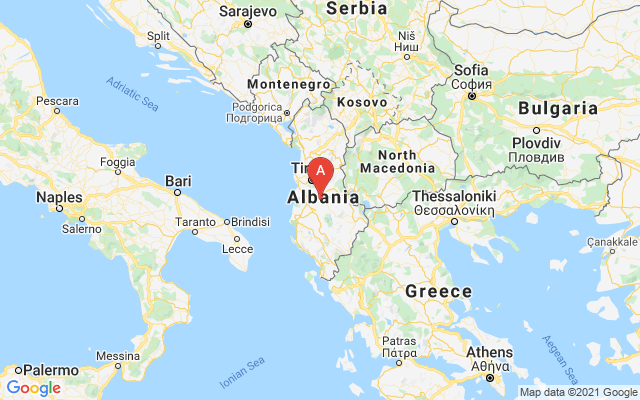
map of Albania
Introduction:
Between 1990 and 1992 Albania ended 46 years of xenophobic Communist rule and established a multiparty democracy. The transition has proven difficult as successive governments have tried to deal with high unemployment, widespread corruption, a dilapidated infrastructure, powerful organized crime networks with links to high government officials, and disruptive political opponents. International observers judged parliamentary elections in 2001 and local elections in 2003 to be acceptable and a step toward democratic development, but identified serious deficiencies. Many of these deficiencies have been addressed through bi-partisan changes to the electoral code in 2003 and 2005, but implementation of these changes will not be demonstrated until parliamentary elections in July 2005.
GEOGRAPHY
Country name: conventional long form: Republic of Albania
conventional short form: Albania
local long form: Republika e Shqiperise
local short form: Shqiperia
former: People's Socialist Republic of Albania
Capital: Tirana
Location: Southeastern Europe, bordering the Adriatic Sea and Ionian Sea, between Greece and Serbia and Montenegro
Geographic Coordinates: 41 00 N, 20 00 E
Area: total: 28,748 sq km
land: 27,398 sq km
water: 1,350 sq km
Area Comparative: slightly smaller than Maryland
Land Boundaries: total: 720 km
border countries: Greece 282 km, Macedonia 151 km, Serbia and Montenegro 287 km
Coastline: 362 km
Maritime Claims: territorial sea: 12 nm
continental shelf: 200-m depth or to the depth of exploitation
Climate: mild temperate; cool, cloudy, wet winters; hot, clear, dry summers; interior is cooler and wetter
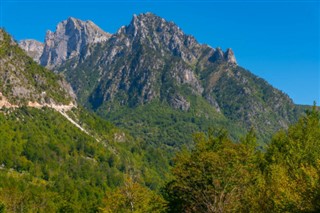
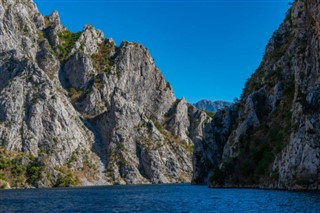
Terrain: mostly mountains and hills; small plains along coast
Elavation Extremes: lowest point: Adriatic Sea 0 m
highest point: Maja e Korabit (Golem Korab) 2,764 m
Natural Resources: petroleum, natural gas, coal, bauxite, chromite, copper, iron ore, nickel, salt, timber, hydropower
GOVERNEMENT
Governement Type: emerging democracy
Administratives Divisions: 12 counties (qarqe, singular - qark); Qarku i Beratit, Qarku i Dibres, Qarku i Durresit, Qarku i Elbasanit, Qarku i Fierit, Qarku i Gjirokastres, Qarku i Korces, Qarku i Kukesit, Qarku i Lezhes, Qarku i Shkodres, Qarku i Tiranes, Qarku i Vlores
Independence 28 November 1912 (from Ottoman Empire)
National Holiday: Independence Day, 28 November (1912)
Constitution: a constitution was adopted by popular referendum on 28 November 1998
Legal System; has a civil law system; has not accepted compulsory ICJ jurisdiction; has accepted jurisdiction of the International Criminal Court for its citizens
Suffrage 18 years of age; universal
Executive Branch: chief of state: President of the Republic Alfred MOISIU (since 24 July 2002)
head of government: Prime Minister Fatos NANO (since 31 July 2002)
cabinet: Council of Ministers proposed by the prime minister, nominated by the president, and approved by Parliament
elections: president elected by the People's Assembly for a five-year term; election last held 24 June 2002 (next to be held NA June 2007); prime minister appointed by the president
election results: Alfred MOISIU elected president; People's Assembly vote by number - total votes 116, for 97, against 19
Legislative Branch: unicameral People's Assembly or Kuvendi Popullor (140 seats; 100 are elected by direct popular vote and 40 by proportional vote for four-year terms)
elections: last held 24 June 2001 with subsequent rounds on 8 July, 22 July, 29 July, 19 August 2001 (next to be held July 2005)
election results: percent of vote by party - PS 41.5%, PD and coalition allies 36.8%, PDR 5.2%, PSD 3.6%, PBDNJ 2.6%, PASH (now PAA) 2.6%, PAD 2.5%; seats by party - PS 73, PD and coalition allies 46, PDR 6, PSD 4, PBDNJ 3, PASH (now PAA) 3, PAD 3, independents 2; note - seats by party as of January 2005: PS 65, PD and coalition allies 46, LSI 9, PDR 6, PSD 3, PBDNJ 3, PASH (now PAA) 3, PAD 3, PDS 1, independents 1
Judicial Branch: Constitutional Court, Supreme Court (chairman is elected by the People's Assembly for a four-year term), and multiple appeals and district courts
Political parties and Leaders: Agrarian Environmentalist Party or PAA [Lufter XHUVELI]; Christian Democratic Party or PDK [Nikolle LESI]; Communist Party of Albania or PKSH [Hysni MILLOSHI]; Democratic Alliance Party or PAD [Neritan CEKA]; Democratic Party or PD [Sali BERISHA]; Legality Movement Party or PLL [Ekrem SPAHIU]; Liberal Union Party or PBL [Arjan STAROVA]; National Front Party (Balli Kombetar) or PBK [Adriatik ALIMADHI]; New Democratic Party or PDR [Genc POLLO]; Party of National Unity or PUK [Idajet BEQIRI]; Renewed Democratic Party or PDR [Dashamir SHEHI]; Republican Party or PR [Fatmir MEDIU]; Social Democracy Party or PDS [Paskal MILO]; Social Democratic Party or PSD [Skender GJINUSHI]; Socialist Movement for Integration or LSI [Ilir META]; Socialist Party or PS (formerly the Albanian Party of Labor) [Fatos NANO]; Union for Human Rights Party or PBDNJ [Vangjel DULE]
PEOPLE
Population: 3,544,808 (July 2004 est.)
Age structure: 0-14 years: 26.4% (male 489,363; female 446,586)
15-64 years: 65.3% (male 1,184,670; female 1,130,065)
65 years and over: 8.3% (male 135,177; female 158,947) (2004 est.)
Median age: total: 28.2 years
male: 27.6 years
female: 28.7 years (2004 est.)
Nationality: noun: Albanian(s)
adjective: Albanian
Ethnic groups: Albanian 95%, Greek 3%, other 2% (Vlach, Roma (Gypsy), Serb, and Macedonian or Bulgarian) (1989 est.)
note: in 1989, other estimates of the Greek population ranged from 1% (official Albanian statistics) to 12% (from a Greek organization)
Religions: Muslim 70%, Albanian Orthodox 20%, Roman Catholic 10%
note: percentages are estimates; there are no available current statistics on religious affiliation; all mosques and churches were closed in 1967 and religious observances prohibited; in November 1990, Albania began allowing private religious practice
Languages: Albanian (official - derived from Tosk dialect), Greek, Vlach, Romani, Slavic dialects
COMUNICATIONS
Telephones - main lines in use: 255,000 (2003)
Telephones - mobile cellular: 1.1 million (2003)
Telephone system: general assessment: Despite new investment in fixed lines, the density of main lines remains the lowest in Europe with roughly 8 lines per 100 people. However, cellular telephone use is widespread and generally effective.
domestic: offsetting the shortage of fixed line capacity, mobile phone service has been available since 1996; by 2003 two companies were providing mobile services at a greater density than some of Albania's Balkan neighbors
international: country code - 355; inadequate fixed main lines; adequate cellular connections; international traffic carried by microwave radio relay from the Tirana exchange to Italy and Greece (2003)
Radio broadcast stations: AM 13, FM 4, shortwave 2 (2001)
Television broadcast stations: 3 (plus 58 repeaters) (2001)
Internet country code: .al
Internet hosts: 455 (2004)
Internet users:

30,000 (2003)

TRANSPORT
Railways: total: 447 km
standard gauge: 447 km 1.435-m gauge (2003)
Highways: total: 18,000 km
paved: 5,400 km
unpaved: 12,600 km (2000)
Waterways: 43 km (2004)
Pipelines: gas 339 km; oil 207 km (2004)
Ports and harbors: Durres, Sarande, Shengjin, Vlore
Merchant marine: total: 22 ships (1,000 GRT or over) 40,878 GRT/62,676 DWT
by type: bulk 1, cargo 19, petroleum tanker 1, roll on/roll off 1
foreign-owned: Denmark 1, Honduras 1, Netherlands 1
registered in other countries: 7 (2004 est.)
Airports: 11 (2003 est.)
Airports - with paved runways: total: 3
2,438 to 3,047 m: 3 (2004 est.)
Airports - with unpaved runways: total: 8
over 3,047 m: 1
1,524 to 2,437 m: 1
914 to 1,523 m: 2
under 914 m: 4 (2004 est.)
Heliports: 1 (2003 est.)
 
 
Copyright © 1blueplanet.com